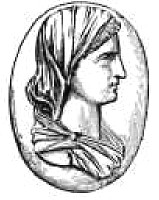


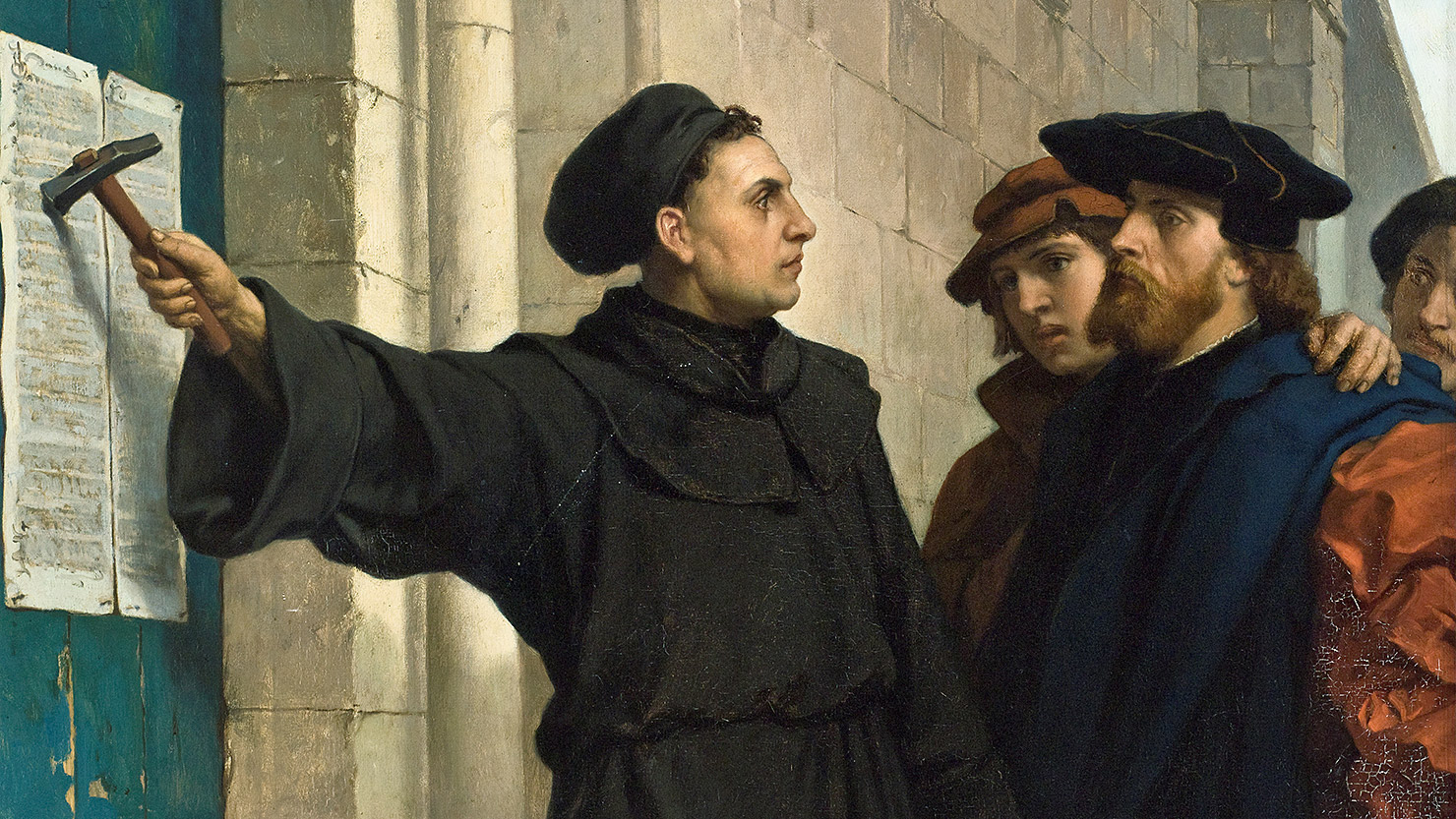

Nearly fourteen centuries before Martin Luther challenged the authority of medieval Rome, Marcion of Sinope had already confronted the deeper error from which Rome itself ultimately inherited its theology. Marcion proclaimed that God the Father revealed by Jesus Christ was not the false deity revealed through Moses, preserved the Evangelicon as the Gospel of the Lord Jesus Christ, and received the Apostolicon as the revelation entrusted by Christ to the Apostle Paul.
For this he was condemned, his writings were destroyed, and his churches were driven from the centers of the emerging Catholic Church.
Yet the questions Marcion raised did not disappear.
They resurfaced in the sixteenth century when an Augustinian monk named Martin Luther stood against the religious establishment of his own age. On October 31, 1517, Luther published his Ninety-Five Theses at Wittenberg, challenging the sale of indulgences and, in time, the authority of a religious system that had accumulated centuries of traditions unknown to the Apostolic Church.
Luther’s great theological recovery was sola fide: justification by faith alone. Returning to the Apostle Paul, he proclaimed that salvation is received through faith in Christ and not earned through works of the Law, religious observances, purchased indulgences, or submission to an ecclesiastical institution.
As the Apostle writes:
“Therefore we conclude that a man is justified by faith without the deeds of the Law.”
—Romans 3:28
For this work, Martin Luther deserves lasting honor.
The Marcionite Church does not regard the Protestant Reformation as an error to be undone, but as a providential movement toward the recovery of the Gospel. Luther courageously opposed genuine corruptions. He rejected papal supremacy, denied that grace could be bought or earned, proclaimed sola fide, and restored the centrality of the Apostle Paul to Christian theology.
Yet the Reformation remained unfinished.
Law and Gospel
Luther struck a mighty blow against Rome, but he did not strike the deeper root from which Rome itself had grown. He dismantled many medieval accretions while retaining the fundamental assumption inherited from the emerging Catholic Church: that the false deity revealed through Moses is identical with God the Father revealed by Jesus Christ.
From the perspective of the Marcionite Church, this was the point at which the Reformation stopped too soon.
The Apostle writes:
“For freedom Christ hath made us free: stand fast therefore, and be not entangled again with the yoke of bondage.”
—Galatians 5:1
Again:
“For when we were in the flesh, the motions of sins, which were by the Law, did work in our members to bring forth fruit unto death.”
—Romans 7:5
And again:
“For the letter killeth, but the Spirit giveth life.”
—II Corinthians 3:6
Paul does not describe Law and Gospel merely as successive stages within one harmonious religion. He places them in opposition. One binds; the other sets free. One brings forth fruit unto death; the other gives life. One belongs to the covenant of bondage; the other reveals the liberty bestowed through Christ.
Marcion received this Pauline distinction without attempting to neutralize it through allegory or harmonization.
No figure of the Protestant Reformation understood the force of Paul’s distinction more deeply than Martin Luther. Romans and Galatians became the foundations of his reforming theology. He declared:
“The law says, ‘Do this,’ and it is never done. Grace says, ‘Believe this,’ and everything is already done.”
Elsewhere he wrote:
“Whoever knows well how to distinguish the Gospel from the Law should give thanks to God and know that he is a theologian.”
Luther recognized that Law and Gospel could not be confused without obscuring grace. Yet he stopped before following that opposition to its theological source. He continued to maintain that the voice which imposed the Law and the Father who bestowed the Gospel were voices of the same God.
Marcion did not.
Sola Fide and the Judgment of Scripture
Luther’s doctrine of sola fide affected more than his understanding of salvation. It also supplied a doctrinal standard by which he evaluated the books traditionally included in the Christian Bible.
In his 1522 New Testament, Luther criticized the Epistle of James as an “epistle of straw” because he believed it contradicted Paul’s proclamation that a man is justified by faith apart from works. He questioned the apostolic authority of Hebrews, expressed reservations about Jude, and initially wrote of Revelation:
“My spirit cannot accommodate itself to this book. For me this is reason enough not to think highly of it. Christ is neither taught nor known in it.”
These were not incidental remarks. Luther was asserting that writings traditionally received as Scripture did not necessarily possess equal apostolic or evangelical authority.
He explained his governing criterion:
“All the genuine sacred books agree in this, that they all preach and urge Christ. This is the true test by which all books are judged.”
Luther summarized this standard as was Christum treibet: what promotes Christ.
Thus, Luther’s canonical reasoning arose from his two central principles. Sola fide measured doctrine according to the Pauline Gospel of justification by faith alone. Sola Scriptura denied that ecclesiastical tradition could establish doctrine merely through its own authority. A book could not be treated as equally authoritative merely because the institutional church had placed it within the Bible. It had to proclaim Christ and accord with the apostolic Gospel.
Fourteen centuries earlier, Marcion had applied the same principle more consistently.
The difference lay not in whether inherited writings could be judged, but in how far the judgment would extend.
Luther’s Apocrypha and Antilegomena
Luther’s Bible made his judgment of inherited writings visible in both the Old and New Testaments.
In the Old Testament, Luther removed the deuterocanonical books from their traditional locations and gathered them into a separate section between the Old and New Testaments. He titled this collection:
“Apocrypha: These books are not held equal to the Holy Scriptures, and yet are useful and good to read.”
Luther therefore distinguished between writings that he regarded as Scripture properly so called and writings that could be read within the Church without being treated as equal authorities for doctrine.
He made a comparable distinction within the New Testament.
Hebrews, James, Jude, and Revelation were moved to the end of Luther’s New Testament after the books he called the “true and certain chief books.” In the table of contents, the first twenty-three books were numbered, while these final four were left unnumbered and separated from the preceding collection. They consequently became known as Luther’s Antilegomena, or disputed books.
Luther did not formally label these four books “New Testament Apocrypha,” nor did he always reject them absolutely. Nevertheless, the structure of his Bible created two visibly subordinate canonical classes: the Apocrypha of the Old Testament and the Antilegomena of the New Testament.
This was a momentous development. Luther had acknowledged in the physical arrangement of the Bible itself that inherited ecclesiastical reception did not make every included writing equally authoritative.
The inherited canon was therefore open to examination in both testaments.
If the Old Testament Apocrypha could be separated from Scripture proper, why should the examination end there?
If James could be judged according to Paul’s proclamation of justification by faith alone, why could Genesis not be judged according to the revelation of God the Father through Jesus Christ?
If Revelation could be questioned because Christ was neither properly taught nor known within it, why should Exodus stand beyond examination?
If Hebrews, James, Jude, and Revelation could be assigned a subordinate place because of their uncertain apostolic or evangelical character, why should every other writing inherited from the emerging Catholic Church be assumed to possess equal authority?
These questions arise from Luther’s own canonical method.
Sola Scriptura and the Problem of the Canon
Luther’s doctrine of sola Scriptura intensified the problem.
By declaring Scripture rather than ecclesiastical tradition to be the supreme rule of faith, Luther deprived the institutional church of the right to settle every controversy merely by appealing to its own authority. Yet once the authority of the church was made subordinate to Scripture, the canon itself could no longer be defended solely by the decree or reception of that church.
Rome could say that the books of the Bible were authoritative because the Church had received and defined them. Luther’s method required a different answer. A writing had to bear witness to Christ and agree with the apostolic Gospel.
Luther therefore established principles by which the inherited canon could be examined:
- Christ stands above ecclesiastical tradition.
- The Gospel stands above inherited attribution.
- Apostolic doctrine stands above customary reception.
- Justification by faith stands above writings that teach righteousness through works.
- Scripture stands above the institution that claims authority to define Scripture.
Luther did not carry these principles to their conclusion.
Marcion had already done so.
Marcion did not restrict canonical examination to the deuterocanonical books or to four disputed New Testament writings. He measured every inherited religious text according to the revelation of God the Father through Jesus Christ and the apostolic witness entrusted to Paul.
No writing stood beyond judgment merely because it was ancient, traditionally attributed to a prophet or apostle, or received by an ecclesiastical institution.
The Plain Sense and the Veil of Moses
Luther’s return to the literal and grammatical sense of Scripture also weakened many of the allegorical harmonizations by which medieval theologians had attempted to unite Moses and Christ.
Medieval interpretation frequently transformed violence into spiritual struggle, legal bondage into evangelical preparation, and the commandments of the false covenant into veiled prophecies of Christ. Luther did not abandon allegory entirely, but his insistence upon the plain meaning of the text made its contradictions with the Gospel more difficult to conceal.
The more directly Moses was read according to his own words, the less plausible it became to present him as a transparent revelation of the Father proclaimed by Christ.
The Apostle writes:
“But their minds were blinded: for until this day remaineth the same veil untaken away in the reading of the false covenant; which veil is done away in Christ. But even unto this day, when Moses is read, the veil is upon their heart. Nevertheless when it shall turn to the Lord, the veil shall be taken away.”
—II Corinthians 3:14–16
Paul does not teach that the veil is removed by interpreting Moses more ingeniously. The veil is removed by turning to the Lord.
Rome preserved that veil beneath accumulated tradition and allegorical harmonization. The Reformers weakened it by returning to Paul, proclaiming sola fide, and distinguishing Law from Gospel. Yet they did not remove it completely because they continued to identify the false deity revealed through Moses with God the Father whom Christ alone made known.
Luther made the veil thinner.
Marcion tore it away.
The Canon of the Gospel
The Marcionite answer is that no writing stands above Jesus Christ.
The Evangelicon is the Gospel of the Lord Jesus Christ. It preserves the revelation of God the Father through the words, deeds, death, and resurrection of His Son.
The Apostolicon is the apostolic witness revealed by the Lord Jesus Christ to the Apostle Paul. It proclaims, defends, and interprets that Gospel for the Church.
Together, the Evangelicon and Apostolicon constitute the Testamentum.
Every other writing must therefore be judged according to the Testamentum. The Evangelicon must not be forced into agreement with Moses. The Apostle Paul must not be subordinated to James. The Gospel must not be interpreted through the false covenant. The true revelation must not be placed beneath writings that obscure or contradict it.
Luther recognized that the books inherited within the Christian Bible did not all possess equal authority. His Apocrypha demonstrated this in the Old Testament. His Antilegomena demonstrated it in the New Testament. His doctrine of sola fide supplied a Pauline criterion for judging doctrine, while sola Scriptura denied that the institutional church could compel Christians to receive its judgments unquestioningly.
But Luther stopped with a canon divided into higher and lower books.
Marcion restored the canon of the Gospel itself.
Completing the Reformation
The Protestant Reformation recovered the Pauline proclamation of justification by faith alone.
It did not recover the Testamentum.
It restored much of Paul’s doctrine.
It did not restore Paul’s canon.
It distinguished Law from Gospel.
It did not acknowledge that this opposition reflects the distinction between the false revelation and the true revelation.
It separated the Old Testament Apocrypha from Scripture proper and subordinated the New Testament Antilegomena to the chief books.
It did not subject the whole inherited canon to the same evangelical examination.
It proclaimed sola Scriptura against the traditions of Rome.
It did not free Scripture from dependence upon a canon whose boundaries had been established by the emerging Catholic Church.
The Marcionite Church therefore does not reject the Reformation. It carries its governing principles to their necessary conclusion.
We affirm sola fide because the Apostle teaches that a man is justified by faith apart from works of the Law.
We affirm the supremacy of the Gospel over ecclesiastical tradition because no institution stands above Jesus Christ.
We affirm Luther’s principle that a sacred writing must proclaim Christ.
We affirm his willingness to distinguish writings of unequal authority.
But we apply these principles without exception.
A writing that contradicts the Apostle Paul should not be received as apostolic Scripture. A writing that obscures Jesus Christ should not be granted authority over His Gospel. A covenant of bondage should not be proclaimed beside the Gospel of liberty as though both proceeded from the same divine source. A canon assembled by the emerging Catholic Church should not be placed beyond examination merely because it was later inherited by Rome and Protestantism alike.
As the Apostle declares:
“For ye have not received the spirit of bondage again to fear; but ye have received the Spirit of adoption, whereby we cry, Abba, Father.”
—Romans 8:15
The work of reformation cannot end while the spirit of bondage continues to be proclaimed beside the Spirit of adoption.
Martin Luther recovered the Pauline doctrine of sola fide. He challenged the authority of Rome through sola Scriptura. He distinguished the Old Testament Apocrypha from Scripture proper and placed the disputed books of the New Testament into a subordinate Antilegomena. He insisted that every sacred writing must be judged according to whether it proclaims Christ.
Marcion had carried that judgment to its necessary conclusion centuries earlier.
The Reformation reaches its completion when the Church returns wholly to the Lord: to Grace rather than Law, to the Evangelicon rather than the false covenant, to the Apostolicon rather than writings contrary to Paul, and to God the Father revealed through Jesus Christ alone.
This is the calling of the Marcionite Church today: to preserve the Gospel without compromise, to uphold the Apostle without contradiction, and to complete the work of reformation by restoring the Testamentum.