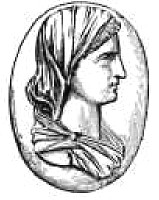


The Chronicon is the historical record of the Marcionite Church, tracing its foundations in Jesus Christ and the Apostle Paul, the life and ministry of Marcion of Sinope, and the development, persecution, and endurance of Marcionite communities throughout the ancient world.
Its name comes from the ancient term Chronicon, meaning a chronicle or account arranged according to time. The title places this work within the early Christian tradition of recording ecclesiastical history year by year, while presenting that history from the perspective of the Marcionite Church.
28 C.E. or 29 C.E.
On either Friday, December 31, 28 C.E., or Saturday, January 1, 29 C.E., Jesus descended from Heaven into Capernaum—either date corresponding with the Sabbath as described in the Evangelicon, depending on whether one follows civil dating (placing the event on the daylight Sabbath) or sunset-to-sunset reckoning (placing it at the Sabbatical boundary).
33 C.E.
Jesus was crucified on Friday, April 3rd, 33 C.E. This corresponds with a ‘Blood Moon’ lunar eclipse that started at 2:01 P.M., about an hour before Jesus’ death on the cross and concluded at 7:34 P.M., lasting exactly 333 minutes. “And it was about the sixth hour, and darkness came over the whole land until the ninth hour. And the sun was darkened, and the veil of the sanctuary was rent in the midst.” Evangelicon 22:59-60
34 C.E.
After the resurrection, the risen Christ appeared to the Apostle Paul and called him by direct revelation. Paul’s apostleship did not come from men, from catechesis, from Ananias, or from the Jerusalem apostles, but from Christ Himself. He did not go up to Jerusalem to receive authority from those who were apostles before him; he went into Arabia and then returned to Damascus, proclaiming the Gospel he had received from Heaven. From this heavenly disclosure, Paul’s mission was grounded in revelation from Christ rather than in the Hebrew Bible, the Twelve, or any human commission.
37 C.E.
After three years of preaching following his revelation, Paul went up to Jerusalem to see Peter and remained with him fifteen days, seeing no other apostle except James. This was Paul’s first direct contact with the Jerusalem leadership after Christ had already called him, yet he did not receive his Gospel from them, nor was his apostleship dependent upon their authority. The visit confirmed the distinction Paul himself maintained: his Gospel came by revelation from Christ, while his contact with Peter and James came only afterward.
37 C.E. to 48 C.E.
After Paul’s brief visit with Peter and James, the theological war among the first Christians continued to harden. Paul carried his Gospel through the regions of Syria and Cilicia, proclaiming grace apart from the Law, while the Judaizing party associated with Peter and James pressed for Christian submission to the Hebrew Bible and its ordinances. These years formed the first great period of Pauline mission: the Gospel revealed by Christ was preached independently of Jerusalem oversight, and the dispute between grace and Law deepened into an open division within the young church.
48 C.E.
When the conflict over Law and grace erupted publicly at Antioch, the Apostle Paul withstood Peter to the face for withdrawing from table fellowship with Gentile believers under Judaizing pressure from men associated with James. The dispute then came to a head at the Apostolic Council of Jerusalem, where Paul went up with Barnabas and Titus because of a revelation and set before Peter, James, and John the Evangelion which he preached among the Gentiles.
Titus, though Greek, was not compelled to be circumcised, and the pillars added nothing to Paul’s Gospel. They gave Paul and Barnabas the right hand of fellowship, asking only that they remember the poor. Thus the Church remembers this council not as Paul’s submission to Jerusalem, but as the confirmation of his independent apostleship and the exposure of the continuing division between grace and Law.
49 C.E.
While in Ephesus, the Apostle Paul pens his first Epistle, the Epistle to the Galatians, using Titus as his courier.
50 C.E.
Written from Ephesus, the Apostle Paul issues the First Epistle to the Corinthians to correct disorder and division within the Corinthian assembly, reaffirming the Gospel of grace against factionalism, and dispatches Timothy as its courier. In this same period, Paul also directs the collection for the poor, extending to Corinth the same charitable obligation he had already appointed in Galatia. This relief effort joined the assemblies of Galatia, Macedonia, and Achaia in material charity while preserving their freedom from the yoke of the Law of Moses.
51 C.E.
Written from Troas, Paul sends the Second Epistle to the Corinthians as a follow-up letter of reconciliation and authority, defending his apostleship and strengthening the Corinthian church; Titus serves as its courier.
52 C.E.
Written from Corinth, Paul composes the Epistle to the Romans as his fullest doctrinal exposition of justification by faith and the righteousness revealed apart from the Law, setting forth the Pauline foundation that later Marcionite churches would treat as central.
53 C.E.
Written from Athens, Paul addresses the Thessalonian believers concerning perseverance, holiness, and the hope of Christ’s return; it is dispatched jointly by Tychicus and Onesimus as its couriers.
54 C.E.
Written from Athens, Paul issues the Second Epistle to the Thessalonians to correct confusion about the Day of the Lord and to reinforce apostolic instruction; Tychicus and Onesimus, as its couriers, carry it. In this epistle Paul also marks the danger of forged letters written in his name, warning the church not to be troubled by any spirit, word, or epistle falsely claiming to come from him. He therefore gives the assemblies his autograph sign: “The salutation of Paul with mine own hand, which is the token in every epistle: so I write.” This practice became an internal witness to the integrity of the Apostolicon and a safeguard against later pseudepigraphal writings issued under Paul’s name.
55 C.E.
The Apostle Paul issues his Epistle to the Laodiceans (commonly identified as Ephesians), his first letter, composed in imprisonment; written from Ephesus and dispatched by Tychicus, the deacon, as its courier.
56 C.E.
Written from Ephesus during imprisonment, Paul sends the Epistle to the Colossians to defend the supremacy of Christ and guard the churches from corrupting teachings; Tychicus and Onesimus, as its couriers, dispatch it.
60 C.E.
The Apostle Paul writes his Epistle to Philemon from Rome in prison, the first Epistle he issues after being transferred in chains from Ephesus to Rome, dispatched by Onesimus as its courier. It is also his first Pastoral Epistle.
61 C.E.
Written from Rome during imprisonment, Paul writes the Epistle to the Philippians as a letter of joy, encouragement, and steadfastness under persecution; Epaphroditus carries it as its courier.
62 C.E.
After his release from prison, the Apostle Paul writes his Epistle to Titus from Athens.
63 C.E.
Written from Laodicea, the First Epistle to Timothy was issued by the Apostle Paul to establish church order and pastoral discipline, instructing Timothy in the oversight of doctrine and ministry; Tychicus dispatched it as its courier. The Apostle also ordained Ignatius as the first Pauline bishop of Antioch, while the Apostle Peter, around the same time, appointed Evodius as the first Petrine bishop of the city.
64 C.E.
During his second imprisonment at Rome, the Apostle Paul writes the Second Epistle to Timothy. Also, according to Marcionite tradition, the Apostle Paul appoints Linus as the first bishop of Rome, establishing the original Pauline foundation of the Roman Church. This early episcopacy stood in contrast to the later Petrine succession claimed by the Catholic tradition.
66 C.E.
Written from Italy as his final Epistle and dictated through his amanuensis—Tertius, his scribe and secretary—the Apostle Paul issues his Epistle to the Alexandrians (Later identified as Hebrews), dispatched by Phoebe of Cenchrea as its courier; within it he names Philologus, the father of Marcion, and possibly Julia, Marcion’s mother, among his companions at Rome.
67 C.E.
The Apostle Paul dies as a martyr in Rome.
70 C.E.
Marcion was born sometime around 70 C.E. in Sinope, a city in Pontus. Marcion was the son of the bishop of Sinope, Philologus of Sinope, who was one of the 70 Disciples, and a companion of the Apostle Paul.
80 C.E.
Following the martyrdom of Linus, Anacletus is appointed as the second and final Pauline bishop of Rome, continuing the apostolic foundation laid by Paul.
92 C.E.
Anacletus’s martyrdom brought the Pauline succession to an end. The Pauline line is eclipsed as the Petrine faction consolidates control, leading to the rise of a single, episcopal succession in Rome under the already reigning Petrine bishop, Clement, who now governed alone.
96 C.E.
The Roman church sent the letter later known as First Clement to Corinth, intervening in a dispute over deposed presbyters and urging the restoration of ecclesiastical order. Though not Marcionite, this letter marks an early stage in the consolidation of Roman ecclesiastical authority, presbyterial succession, and appeal to Hebrew-scriptural examples. In the memory of the Marcionite Church, it stands as an early witness to the Roman mind that would later oppose the Pauline canon and Gospel preserved by Marcion.
98 C.E.
Marcion of Sinope began his ministry in Ephesus as a disciple of the Apostle John. Marcion presents an early compilation of the Pauline Epistles to the Apostle John. This would later be fully transcribed, compiled, and canonized into the Apostolicon. Ignatius, the Pauline bishop of Antioch, is martyred under Emperor Trajan. His death marks the end of the Pauline line of succession in Antioch for many decades.
100 C.E.
John the Apostle dies peacefully in Ephesus.
102 C.E.
Marcion leaves Ephesus to return to his hometown of Sinope to succeed Phocas as the bishop, who himself succeeded Marcion’s father, Philologus, as bishop of the city. Phocas was martyred during the persecution of Christians under Emperor Trajan.
110 C.E.
Marcion leaves Sinope and begins traveling to compile more of the Apostle Paul’s epistles. During this time, Marcion began to evangelize throughout Anatolia. Polycarp, in his Epistle to the Philippians, makes a veiled reference to Marcion’s evangelistic activity in Anatolia, casting it in a negative light.
112 C.E.
Pliny the Younger, governing Bithynia and Pontus, writes to Trajan describing Christian practice in Pontus during the episcopate of Marcion of Sinope: believers meet on a fixed day before dawn, sing a hymn to Christ “as to a god,” bind themselves by oath to avoid crimes, and later share an ordinary meal; he also interrogates two female deaconesses in the course of his inquiry.
117 C.E.
Marcion of Sinope begins founding and organizing Pauline congregations across Anatolia.
120 C.E.
Marcion of Sinope fully assembles and transcribes the original Epistles of Paul into a single corpus known as the Apostolicon.
125 C.E.
Marcion of Sinope completes the compilation of the forty-two-psalm Psalmicon, the first Christian hymnbook. Composing some psalms himself and gathering others from the worship of Greek- and Syriac-speaking Pauline churches, and orders them into a common collection for liturgical use.
128 C.E.
Marcion of Sinope combines the Apostolicon with the Gospel of the Lord Jesus Christ (the Evangelicon) into a single codex—the Testamentum, the first Christian Bible—excluding the Hebrew Bible. This date is justified by Eznik of Kolb’s report that Marcion fixed Christ’s appearance roughly 100 years before Marcion canonized his Bible. If Christ’s descent is dated to December 31st 28 C.E. (or January 1st 29 C.E.), then roughly one hundred years later marks the point at which Marcion bound Gospel and Apostle together as a single canon.
132 C.E.
Marcion of Sinope delivered his Homily to Diognetus at one of his churches in the city of Smyrna in Anatolia. This popular homily would later be transcribed and circulated across the Christian world. It is considered the earliest piece of Christian apologetic literature.
135 C.E.
Following the suppression of the Bar Kokhba revolt and the refounding of Jerusalem as Aelia Capitolina, Marcus became the first Gentile bishop of the city, bringing to an end the former succession of bishops from the circumcision. The exclusion of Jews from the refounded city and the suppression of Jewish institutions made the continuation of a Christian episcopate ordered according to circumcision, the Mosaic Law, and Jewish observance increasingly untenable. The new Gentile episcopate therefore developed upon a Pauline foundation, independent of the Judaizing tradition. The Marcionite Church accordingly remembers Marcus and the Gentile succession beginning with him as Pauline and proto-Marcionite, preceding the formal separation of the Marcionite Church from Rome in 144 C.E.
Marcus would later be employed as one of the heterodox interlocutors representing Marcionite doctrine in the Dialogue of Adamantius, wherein he presents a distinct form of the Marcionite tradition alongside Megethius.
135 C.E. to 138 C.E.
Sometime in the late 130s C.E., Marcion of Sinope arrived in Rome, joined the Roman church, publicly taught, and secured influence with a reported donation of 200,000 sesterces. Jerome records that Marcion sent a woman ahead of him to Rome to prepare the community for his arrival and win adherents in advance. She is commonly identified as Philumena, described in later sources as a deaconess and prophetess associated with Marcionite circles. In this same Roman setting, Marcion advanced his Apostolicon, a defined collection of Pauline epistles, marking the earliest clear record of a structured Pauline corpus publicly circulating in the capital.
138 C.E.
During Hyginus’s episcopate, Cerdo of Syria was expelled from the Roman church. Portrayed by later sources as repeatedly feigning repentance before returning to his doctrine, Cerdo stands as a clear proto-Marcionite and contemporary of Marcion himself, advancing in Rome the theology that would soon erupt into the broader Marcionite schism. His removal marks an early and decisive confrontation between Roman ecclesiastical authority and the emerging Marcionite current.
139 C.E.
The Chronicle of Edessa preserves a terse local notice (Seleucid year 449 = 139 C.E.): “In the year 449 Marcion forsook the Catholic Church.” Marcionite chronology treats this remembered “forsaking” as the date of composition of the Antitheses. Yet Marcion’s formal separation as an institution would not occur until July 15th, 144 C.E., when he was summoned before the Roman presbytery, expelled, and then organized his own Pauline church.
142 C.E.
Following the death of Bishop Hyginus, Marcion of Sinope sought to become Bishop of Rome in an effort to restore the church to its original Pauline foundation. Despite his growing influence and generous donation of 200,000 sesterces, his bid was rejected in favor of Pius, a proponent of the emerging Petrine-Catholic tradition. After his rejection in Rome, Marcion traveled east and was appointed Bishop of Antioch. There, he restored the Pauline faction to power, reclaiming a see that had been dominated by Petrine influence since Ignatius died in 98 C.E. Under Marcion’s leadership, Antioch once again became a center of Pauline theology and ecclesiastical independence.
144 C.E.
Conflicts with the Church of Rome escalated, and Bishop Pius formally excommunicated Marcion of Sinope on July 15th, 144 C.E., denouncing him as a heretic and returning his donation of 200,000 sesterces. Tertullian preserves the date indirectly by counting Marcion’s separation as 115 years and six and a half months after the crucifixion of Jesus. Thus even hostile Catholic chronology preserved the formal date of the Marcionite schism. Following his trial of excommunication, Marcion is said to have declared to the assembled Roman presbyters and bishops: “I will divide your Church and cause within her a division, which will last forever.” After his excommunication, Marcion fully broke from Rome, transforming his Pauline faction into a separate church independent of the Petrine hierarchy. He based this new Church in Antioch, where he assumed the title of Archbishop and established an ecclesiastical structure grounded in the authority of Paul alone. From there, Marcion led a growing network of congregations throughout Anatolia, Syria, and beyond, proclaiming the Gospel of grace, rejecting the Hebrew Bible as Christian scripture, and refusing to identify the false deity portrayed therein with God the Father revealed by Jesus Christ. Sometime later, in response to Marcion’s growing influence in the East, Rome appointed Heron II as a competing Petrine bishop in Antioch, directly opposing Marcion’s episcopacy and attempting to reassert Catholic control over the see. This dual episcopate in Antioch became a symbol of the wider schism between the Church of the Law and the Church of grace.
148 C.E.
Gaianus succeeded Marcus as Bishop of Aelia Capitolina, continuing the Pauline episcopal succession of the city. Following the formal separation of the Marcionite Church from Rome in 144 C.E., the episcopate of Aelia Capitolina stood within the wider Pauline and Marcionite communion.
150 C.E.
During the episcopate of Bishop Pius I, his brother Hermas circulated the Shepherd of Hermas, with the Book of Similitudes framed as a deliberate response to Marcion and his Antitheses, offering a rival “visionary” and moral-theological counter-program to Marcionite contrasts.
154 C.E.
Marcion of Sinope is arrested in Antioch and taken back to Rome to be martyred in the Colosseum. During his journey, he pens seven epistles for some of his churches and disciples in Anatolia. His Epistle to the Romans was written on August 24th.
After arriving in Rome, he confronts his archnemesis, Polycarp of Smyrna, who exclaims: “I recognize thee as the firstborn of Satan.” Writing within Marcion’s own lifetime, Justin Martyr provides early-datable references to Marcionite Christianity in the First Apology, complaining that Marcion’s teaching had already spread among every race of men, and he is also associated with a now-lost work, Against Marcion. Justin’s testimony confirms how rapidly Marcionite assemblies spread across the Roman world and forced the Catholic party into public apologetic damage control.
By the middle of the second century, the Marcionite Church was not merely a school of opinion but a visible ecclesiastical network. Hostile witnesses place its reach from Rome and Carthage in the west, through Gaul, Corinth, and Antioch, and into Edessa, Nisibis, Armenia, and Persia. These assemblies possessed bishops, presbyters, deacons, catechumens, scriptures, liturgy, property, copyists, and lines of communication between cities.
After Marcion’s martyrdom, the Marcionite Church did not fragment into unrelated sects. Rather, distinct internal schools emerged within the same broad ecclesial body. The two principal schools were the Apelleans, founded by Apelles of Alexandria, and the Lucanists, founded by Lucanus or Lucianus of Rome. Later developments included the Severians, associated with Severus, and the Preponian refinement within the Lucanist stream. These schools differed chiefly in how they described the lower powers beneath God the Father, not in confessing rival co-eternal gods.
155 C.E.
Shortly after Marcion of Sinope’s death, a pre-ecumenical Roman synod was held where Polycarp of Smyrna conferred with Bishop Anicetus over the Paschal (Easter) dispute—a Judaic Nisan 14 observance versus a Sunday rule—explicitly rejecting the Marcionite astrological method of calendrical calculation, which embraces celestial computations anchored to the April 3rd, 33 C.E. lunar eclipse visible at Jerusalem. Apelles of Alexandria succeeds Marcion of Sinope, following his martyrdom, as Archbishop of the Marcionite Church. Apelles becomes the chief preserver and theological successor of Marcion’s original teaching, giving rise to the Apellean school. The Apelleans preserved the confession of God the Father above all. They understood the lower maker of the physical world as the being called in the Apostolicon “the god of this world” and called in the Evangelicon “the prince of this world.” This lower power was not a second co-eternal, co-equal god, but a subordinate, begotten, limited, and derivative power beneath God. Marcionite tradition holds that Apelles continued the collection and transcription of Pauline letters after Marcion’s death and received Titus, I Timothy, II Timothy, and Alexandrians for Marcionite use. The Marcionite Church preserves these writings in the Antilegicon as deuterocanonical and subordinate to the original Apostolicon. Apelles may also have composed prologues for these epistles after the manner of Marcion’s prologues.
156 C.E.
Metrodorus, the Marcionite bishop of Smyrna, was burned alive along with Polycarp, the Catholic bishop of Smyrna, during the persecutions of Christians in Asia Minor under Antoninus Pius.
157 C.E.
Lucanus, also known as Lucianus of Rome, emerges as an important disciple of Marcion and the founder of the Lucanist school. The Lucanists preserved the confession of God the Father above all, but developed Marcionite cosmology by distinguishing the just “god of this world” from Satan. In this structure, the “god of this world” is the just lower power associated with the making and governance of the physical world, while Satan is the evil adversary. This was not dualism, for neither the “god of this world” nor Satan was treated as co-eternal or co-equal with God the Father.
160 C.E.
Cassianus succeeded Gaianus as Bishop of Aelia Capitolina, continuing the Pauline and Marcionite episcopal succession of the city. The ancient chronographic tradition places Cassianus in the twenty-third year of Antoninus Pius, corresponding to 160 C.E.
Theodotion, originally a Marcionite Christian proselyte from Ephesus, produced a Greek translation of the Hebrew Scriptures, most notably a recension of Daniel that later supplanted the older Septuagint form in wider church use. Circulating within Marcionite circles, his Greek scriptures would have supplied a usable textual base for anti-Mosaic polemics. They may have been employed in the composition of Apelles’ Syllogisms, the systematic critique of contradictions attributed to the Mosaic law. The first generation after Marcion includes several named disciples and teachers preserved by hostile heresiological witnesses: Potitus, Basilicus, and Syneros. Potitus and Basilicus are best placed within the Apellean stream, preserving the simpler distinction between God the Father and the lower powers associated with the making and governance of the physical world. Syneros is best placed within the Lucanist stream, since the hostile report of “three natures” fits the Lucanist tendency to distinguish among lower powers rather than collapse them into a single figure. These differences represented internal theological tendencies within the Marcionite Church rather than formal schisms.
167 C.E.
Apelles begins circulating his Syllogisms, a multi-volume anti-Hebrew Bible project that later writers attest ran to at least 38 books. Building on Marcion’s earlier Antitheses, the work extends the same polemical program by systematically cataloging contradictions and arguing that the Hebrew Scriptures’ testimony about God is false. Apelles also articulates a distinctly Marcionite doctrine of deferred demiurgy, describing the lower maker of the physical world as a fiery angel who attempted to imitate the higher realm but failed to reproduce its perfection. Against hostile accusations of docetism and crude dualism, Apelles affirmed Christ’s real manifestation. They clarified that the lower maker of the physical world was subordinate to God the Father, not a second co-eternal, co-equal god.
168 C.E.
By this year the Pauline and Marcionite episcopal succession of Aelia Capitolina had continued through Cassianus, Publius, Maximus, Julianus, Gaius, Symmachus, and Gaius II. The ancient chronological tradition places the end of the episcopate of Gaius II in 168 C.E. He was succeeded by Julianus II.
The succession thereafter continued through Julianus II, Apion, Antonius, Valens, and Dolichianus. The precise years of these intervening episcopates are imperfectly preserved
169 C.E.
Theophilus of Antioch begins to rework and alter the Evangelicon, adding new material, removing other material, and changing passages he regarded as necessary for a Gospel. The resulting text would later circulate under the title Gospel of Luke. Eusebius also reports that Theophilus of Antioch wrote a now-lost discourse “of no common merit” against Marcion, evidence that Antioch’s Catholic leadership treated Marcionism as a major public threat even while competing textual and doctrinal claims were hardening into rival canons.
170 C.E.
The distinction between the ‘Old’ and ‘New’ testaments started around 170 C.E. when Melito of Sardis coined those terms. This was done as a direct response to the teachings of Marcion of Sinope.
171 C.E.
Dionysius of Corinth pens a letter to the Nicomedians against Marcionism, preserved only through a later notice in Eusebius’ Ecclesiastical History. Sometimes described as a refutation circulated toward Rome as well, the work itself is lost and survives only in mediated report. Nevertheless, it demonstrates that by the 170s, Marcionism had achieved sufficient prominence to provoke coordinated campaigns of episcopal correspondence aimed at doctrinal containment.
172 C.E.
Philip of Gortyna wrote a treatise, now lost, against Marcion.
175 C.E.
A Catholic presbyter in Anatolia composes the Acta Pauli cycle, including the forged and pseudigraphical Corinthian correspondence (3 Corinthians), as a counter to the popularity of Marcionite teaching rooted in the Apostle Paul.
180 C.E.
According to Jerome, Modestus wrote a work, now lost, entitled Adversus Marcionem, attacking Marcion of Sinope. According to Eusebius, this work exceeded all other confutations of Marcion.
181 C.E.
The Acts of Peter began to take form as a Petrine romance against Marcion and the Marcionite churches. In this writing, Paul first preaches at Rome and then departs for Spain; afterward Simon Magus enters the city, deceives many, and lodges in the house of Marcellus, a wealthy Roman patron whose house serves widows, orphans, strangers, and the poor. Marcellus, whose name means “little Mark,” functions as a literary mask for Marcion, and his house represents a Pauline Roman church-house reclaimed by Peter.
The work answers Marcionite Pauline priority by granting that Paul first formed the Roman mission, but making Peter the apostle who rescues it after Paul’s departure. Simon is made the open mask of heresy, honored as a “new god” and set against the confession of Christ; Marcellus preserves the deeper anti-Marcionite target. The story also answers a rival Gospel-reading in which Peter’s denial, doubt upon the waters, and failure to understand Christ were used against the Petrine claim.
185 C.E.
Following Dolichianus, Megethius became Bishop of Aelia Capitolina, continuing the Pauline and Marcionite episcopal succession of the city. Megethius is identified by the Marcionite Church with the figure transmitted in the later ecclesiastical tradition as a second Maximus. The names themselves support the identification, Megethius and Maximus bearing corresponding senses of greatness in Greek and Latin. The Church therefore recognizes the earlier Maximus as the sole bishop properly bearing that name and restores the later bishop under his proper name, Megethius.
Megethius would later be employed as one of the principal heterodox interlocutors representing Marcionite doctrine in the Dialogue of Adamantius, alongside Marcus, preserving his name and a distinct Lucanist form of the Marcionite tradition.
In the same year, Megethius presents a Marcionite disputation against Hermogenes, arguing that matter is not eternal, that no second uncreated principle exists beside God, and that evil arises not from matter itself but from disordered will, corruption, and misuse.
189 C.E.
By this year Narcissus had succeeded Megethius as Bishop of Aelia Capitolina, continuing the Pauline and Marcionite episcopal succession of the city.
During his episcopate, Narcissus and Theophilus of Caesarea presided over the bishops assembled in Palestine concerning the Paschal controversy. They defended the observance of the Resurrection upon the Lord’s Day and maintained that the Paschal observance should be concluded upon that day, rather than being bound to the fourteenth day of the Jewish month. Narcissus thus stands within the Marcionite episcopal succession as an early witness to the separation of the Christian observance of the Resurrection from the Jewish Passover.
Writing only decades after Marcion’s death, Irenaeus, the earliest substantial witness to Marcionite Christianity, provides crucial context for Marcionite theology and preserves readings closer to the original Marcionite texts than any later source. His testimony establishes the baseline against which all other witnesses are measured.
190 C.E.
Palut arrives in Edessa and finds that Marcionites constitute the overwhelming majority of the city’s Christian population and are known simply as “Christians.” Palut’s Catholic followers are therefore labeled “Palutians,” a designation that reflects their minority status and their organization under the Catholic Bishop of Antioch, Serapion. Palut’s mission represents an effort to introduce a Catholic structure into a city whose Christian identity had already developed within a Marcionite framework.
192 C.E.
Rhodon, often Latinized “Rhodo,” publishes a now-lost treatise against Marcionite Christianity. Eusebius preserves fragments in which Rhodo debates Apelles and reports internal Marcionite distinctions among Apelles, Potitus, Basilicus, and Syneros. Although Rhodo frames these differences in hostile terms of “principles” and “natures,” the testimony is valuable because it preserves evidence of distinct schools within a single Marcionite body: the Apellean tendency associated with Apelles, Potitus, and Basilicus, and the Lucanist tendency associated with Lucanus and Syneros. These differences did not amount to formal schisms from the Marcionite Church, but to internal schools of interpretation concerning the order of lower powers beneath God the Father.
193 C.E.
Apelles of Alexandria, the foremost disciple and theological successor of Marcion, dies in Alexandria, Egypt. His death marks the close of the first major phase of post-Marcionite leadership. Still, the Apellean school continues as the principal continuation of Marcion’s original teaching: public Gospel, Pauline canon, rejection of the Hebrew Bible as Christian scripture, real manifestation of Christ, and deferred demiurgy beneath the sovereignty of God the Father.
194 C.E.
Severus, a disciple and successor of Apelles, gives rise to the Severians, a stricter ascetic development within the broader Apellean stream. Like the traditional Apelleans, the Severians identified Satan with the being called in the Apostolicon “the god of this world” and called in the Evangelicon “the prince of this world.” Unlike traditional Apelleans, however, they treated this lower maker of the physical world not merely as just, limited, and inferior, but as evil. This led the Severians toward a more ascetic, world-denying posture, while still rejecting the Hebrew Bible as a false authority and denying the fleshly resurrection.
196 C.E.
Jerome, in his work De viris illustribus, mentions two Christian theologians, Appion and Candidus, who jointly wrote a treatise defending the six-day creation myth from the Book of Genesis in the Hebrew Bible. This treatise was directed against the theology of Marcion, who denied the creation story in the Book of Genesis.
200 C.E.
Bardesanes of Edessa composed Syriac dialogues against Marcion’s followers, later translated into Greek by his circle. Eusebius presents him as a learned regional counter-voice in the Syriac milieu where Marcionite churches were especially entrenched.
203 C.E.
Clement of Alexandria—the learned Alexandrian theologian—completes the Stromata (“Miscellanies”) as an early Alexandrian witness that, in the midst of the broader second-century contest over canon and doctrine, engages (among many targets) Marcionite teaching and exegesis; his scattered references offer valuable glimpses of how Marcionite interpretation was received and contested within the intellectual circles of Alexandria.
204 C.E. to 212 C.E.
Tertullian’s Adversus Marcionem—the most extensive anti-Marcionite treatise extant, spanning five books—was composed and repeatedly revised roughly sixty years after Marcion’s death: begun around 204, expanded as Books I–III circa 207–208, and completed in its familiar five-book form with Books IV–V in the period 208–212; and though fiercely polemical, it quotes the Marcionite Evangelicon and Apostolicon extensively (often verse-by-verse), yielding the densest concentration of recoverable Marcionite readings, with Latin renderings that preserve textual variants otherwise lost and thereby making the work, ironically, a major source for reconstructing much of Marcion’s Testamentum.
Tertullian also shows that Marcionite communities in his own day were organized churches with clergy, canon, liturgy, and institutional memory. His argument is not that the Marcionites lacked bishops, scriptures, or succession, but that their succession and scriptures should be rejected. His polemic therefore preserves evidence of a serious ecclesiastical body rather than a loose private sect.
212 C.E.
Tertullian composed the now-lost Adversus Apelleiacos (“Against the Apelleians”), directed against Apelles, the chief disciple of Marcion, and his followers. The existence of this work confirms that the Apellean school remained a distinct and important Marcionite stream after Apelles’ death. Around the same period, Ambrose of Alexandria, formerly a Marcionite, enters Origen’s school in Alexandria and is converted to Catholicism, later becoming Origen’s close companion and a principal patron of his scriptural commentaries. Because Apelles himself was associated with Alexandria, Ambrose’s Alexandrian connection makes him a likely former Apellean who later became an Origenist. However, surviving sources do not explicitly label him as such.
216 C.E.
The episcopate of Narcissus at Aelia Capitolina came to an end. With the establishment of Alexander in the bishopric, the Marcionites lost control of the see of Aelia Capitolina, bringing to a close the Pauline and Marcionite episcopal succession of the city which the Church traces from Marcus. Thereafter the bishopric passed into the Catholic episcopal succession.
218 C.E.
In Edessa, Prepon the Assyrian, a follower of Marcion, writes a treatise “inscribed to Bardaisan the Armenian,” explicitly defending Marcionite principles against Bardaisan’s system and followers, as reported by Hippolytus. Prepon belongs naturally within the later Lucanist stream, since he articulated a threefold distinction between what is good, what is just, and what is evil. Within Marcionite theology, this should not be understood as belief in three co-eternal gods, but as a description of the order of lower powers, principalities, thrones, and dominions beneath God the Father. Prepon’s teaching refines the Lucanist distinction between the just “god of this world” and Satan as the evil adversary.
220 C.E.
Callixtus, the Catholic Bishop of Rome, interpolated, readdressed, and expanded Marcion’s epistles in 220 C.E. to garner support for a monarchical episcopate. Callixtus reattributed the epistles from Marcion of Sinope to the early Christian martyr, Ignatius of Antioch.
230 C.E.
Hippolytus of Rome, a contemporary of Tertullian, writes against Marcion in his Refutatio Omnium Haeresium, offering independent testimony through a systematic catalog of heresies. His notice concerning Prepon the Assyrian preserves an important witness to later Lucanist cosmology, especially the distinction between the good, the just, and the evil. Although Hippolytus frames these claims polemically, his testimony helps confirm that Marcionite schools continued to refine the doctrine of lower powers beneath God the Father without teaching a second co-eternal, co-equal god.
240 C.E.
Commodian wrote a lengthy poem against Marcion of Sinope in doggerel hexameters. Around the same period, the first anti-Marcionite prologue was appended to the Gospel of Mark. It was composed within a milieu shaped by ongoing resistance to Marcionite textual claims. This preface reinforces traditional narratives of apostolic mediation and succession, thereby stabilizing Mark’s connection to Petrine authority. In an environment where Gospel authorship and transmission were contested, such framing served a defensive purpose, firmly embedding Mark within the emerging fourfold Gospel canon.
245 C.E.
The second anti-Marcionite prologue is appended to the Gospel of Luke. It identifies Luke as a Syrian of Antioch, a physician, and a close companion of Paul. By stressing Luke’s orthodox credentials and affirming the integrity of his narrative, the prologue counters the Evangelicon’s apostolicity and reasserts Luke’s place within the broader catholic canon. Its emphasis on authorship, geography, and apostolic association reflects a period when control over textual lineage was central to ecclesiastical authority.
248 C.E.
Origen—the preeminent biblical scholar of the early Catholic Church—treats Marcionites in Contra Celsum as a recognized Christian constituency within the third-century landscape, and in his commentaries and homilies, he engages Marcionite exegesis at length, frequently preserving variant Marcionite readings even as he argues against their theological implications; his Greek testimony is therefore a crucial control for checking and corroborating the Latin evidence preserved in Tertullian.
250 C.E.
A Johannine anti-Marcionite prologue that explicitly names Marcion as a disciple of John was produced as part of the church’s ongoing effort to define the boundaries of the Gospel corpus. By grounding the Fourth Gospel in apostolic testimony and distancing it from heterodox interpretation, the text directly confronts Marcionite theology. Its polemical clarity and canon-conscious framing align with broader 3rd-century attempts to consolidate the fourfold Gospel against rival textual traditions.
254 C.E.
The Catholic Bishop of Rome, Stephen I, recognizes Marcionite baptisms as valid.
256 C.E.
During the baptismal controversy, Cyprian of Carthage fiercely opposed Stephen of Rome’s recognition of baptisms administered outside the Catholic Church. In this dispute, Marcionite baptism is named directly, showing that the sacramental practice of Marcionite communities was recognizable enough to be debated as baptism rather than dismissed as no rite at all.
This controversy unintentionally confirms the ecclesial reality of the Marcionite Church in the third century. Its assemblies did not merely possess opinions, but administered sacraments, received converts, and maintained rites sufficiently stable that Catholic bishops were forced to decide whether those rites should be accepted or rejected.
257 C.E.
Eusebius makes mention of an unnamed Marcionite woman—possibly a deaconess—who was executed in the arena of Caesarea around 257 C.E., during the reign of Emperor Valerian.
300 C.E.
Adamantius completes his dialogue De Recta in Deum Fide, one of the most prominent refutations of Marcionite Christianity. Through its disputational format between orthodox and Marcionite spokespeople, it preserves Marcionite exegetical methods and direct scriptural appeals. The dialogue is especially important because it partially preserves the older division between Marcionite schools: Marcus represents the Apellean stream, preserving the simpler structure that identifies the lower maker of the physical world with the power called in the Apostolicon “the god of this world” and in the Evangelicon “the prince of this world.” In contrast, Megethius represents the Lucanist stream, distinguishing the good, the just, and the evil. The presence of named Marcionite disputants shows that Marcionite teachers were still remembered as public, articulate, and confident defenders of their tradition nearly two centuries after Marcion’s break with Rome. The dialogue also preserves Marcionite ransom logic, in which Christ purchases souls out of bondage and transfers them from the dominion of lower powers into the liberty of God the Father.
301 C.E.
Gregory the Illuminator converts Tiridates III, King of Armenia, to the Christian Faith, and Armenia becomes the first kingdom to receive Christianity as its national religion. Gregory belongs to the eastern Apostolic tradition preserved among the Marcionite churches, whose presence in Armenia and the surrounding lands endured for centuries. His teaching preserves the confession also attributed directly to Marcion, “We are the price of the blood of Jesus,” declaring likewise, “For we are the price of the Blood of Thy Son.” Thus the first Christian kingdom is established under a form of the Faith belonging to the Marcionite tradition, though Gregory and the conversion of Armenia would afterward be claimed and recast by the later Armenian Church.
304 C.E.
The heresiological catalog Adversus omnes haereses (Pseudo-Tertullian) circulates as an appendix to Tertullian’s De praescriptione, listing dozens of “heresies” (including Marcionites) and drawing (directly or indirectly) on the lost Syntagma associated with Hippolytus of Rome; it is commonly judged non-Tertullianic and is sometimes linked to Victorinus of Pettau. Its notices on Lucanus, Apelles, and the later Marcionite tradition are useful for tracing the memory of distinct Marcionite schools. However, its hostile summaries often compress Apellean, Lucanist, and Severian tendencies into simplified accusations of “principles.”
310 C.E.
On January 10th, 310 C.E., during the Diocletianic Persecution, Asclepius, the Marcionite bishop of Eleutheropolis, was burned alive in Caesarea on the same pyre as Peter Apselamus.
313 C.E.
With the Milan settlement of 313, Constantine and Licinius ended the era of state persecution and inaugurated what later Christians called the “peace of the Church”: Christian assemblies were legalized, and confiscated property was ordered restored (or compensated). For Marcionite congregations—already widespread—this moment marks the first plausible transition from hunted, precarious meetings to open worship under imperial toleration, even as the same imperial “peace” would soon be leveraged by Catholics to police “heresy” and target rival Pauline churches as illicit.
318 C.E.
Paul of Lebaba, a Marcionite presbyter, erected a church in the Syrian village of Lebaba on October 1st, 318 C.E. The inscription within the church is the oldest known surviving inscribed reference to Jesus: “The meeting-house of the Marcionites, in the village of Lebaba, of the Lord and Saviour Jesus the Good – Erected by the forethought of Paul a presbyter, in the year 630 Seleucid era.”
324 C.E.
Eusebius publishes his Ecclesiastical History, preserving multiple early notices about Marcionites and earlier anti-Marcion polemic—an anchor witness for how fourth-century Catholic writers framed Marcionite persistence and opposition.
325 C.E.
Emperor Constantine, a worshipper of the Roman Sun God, convened the Council of Nicaea and ordered the books of the Hebrew Bible to be added to the Christian Bible in a bid to unite citizens under a single state religion. The Evangelicon is excluded from that codex and replaced with scriptures of unknown origin.
331 C.E.
In 331 C.E., six years after the Council of Nicaea disbanded, Constantine ordered 50 copies of the edited Bibles to be published; these contained the Hebrew Scriptures and several new gospels.
332 C.E.
In 332 C.E., Emperor Constantine announced his Edict Against the Heretics. He ordered all Marcionite Christian churches and meeting places to be confiscated by force and handed over to the Catholic Church. This marked the beginning of systematic imperial suppression of Marcionite worship under Christian emperors. Buildings were seized, manuscripts were targeted, public assembly was criminalized, and the material memory of the Marcionite Church was deliberately broken. This was not a theological refutation of Marcionite Christianity, but the beginning of its political suppression under Christian imperial power.
340 C.E.
Hegemonius assembles the Acts of Archelaus, and its core is a recycled anti-Marcion corpus. It hijacks Marcion’s own antithesis-style contrasts, flips them into accusations, and then redeploys the package as a broader anti-heretical polemic.
348 C.E.
Cyril of Jerusalem warns catechumens that Marcionite assemblies could be mistaken for “the Church” while traveling, since they, too, styled their meeting places as “the Lord’s House.” He therefore instructs the faithful to ask for the Catholic Church explicitly. This caution attests to how closely the Divine Liturgy of the Marcionite Church resembled contemporary Catholic worship in its prayers, sacraments, and outward forms.
360 C.E.
At the Council of Laodicea in 360 C.E., it was decreed that no psalms composed by uninspired men should be used in the Church service. The Marcionite Christian Psalmicon was thus banned despite its growing popularity.
363 C.E.
Ephrem the Syrian composed the Discourses to Hypatius, prose refutations directed against Mani, Marcion, and Bardaisan. The Third Discourse takes up Marcion in sustained argument, demonstrating that in the Syriac world Marcionism remained a live and organized rival well into the fourth century. With Ephrem’s relocation to Edessa, his preaching and hymnody unfold within a contested ecclesial environment where Marcionite claims are explicitly targeted—clear evidence of Marcionite strength in Edessa during the later fourth century. His extensive refutations provide crucial testimony both to the Syriac transmission of Marcionite texts and to the tradition’s continued independent development beyond Greek and Latin Christianity.
374 C.E.
Epiphanius of Salamis composed the Panarion, a comprehensive heresiological encyclopedia cataloging heresies down to his own time. By dedicating substantial attention to Marcionite Christianity, he becomes the second main source of information on the Testamentum, claiming access to Marcionite manuscripts and preserving textual variants, theological interpretations, and liturgical practices from communities still active in his day. His accounts of Apelles, Severus, Lucanus, and related teachers are hostile and often distorted, but they remain important for reconstructing the Apellean, Lucanist, and Severian streams of Marcionite theology.
375 C.E.
In his First Canonical Epistle to Amphilochius of Iconium, Basil of Caesarea names the Marcionites among the heresies “alien from the faith”.
378 C.E.
Ambrose of Milan composed his first work, De Paradiso, which contains some commentary attacking the theology and doctrine of Apelles of Alexandria.
380 C.E.
On February 27th, 380 C.E., Emperors Theodosius I, Gratian, and Valentinian II issued the Edict of Thessalonica, requiring the peoples of the Roman Empire to follow the Nicene faith associated with the bishops of Rome and Alexandria. This law did not yet name Marcionites specifically, but it marked a decisive shift: Catholic orthodoxy was no longer merely one church tradition among others, but the religious standard favored by imperial law.
381 C.E.
The First Council of Constantinople reaffirmed Nicene theology and gave fuller form to the Nicene-Constantinopolitan Creed. From the Marcionite perspective, this council belongs to the later Catholic consolidation of doctrine: a fourth-century imperial and episcopal settlement that arose long after the Evangelicon, Apostolicon, and original Testamentum had already been published by Marcion.
382 C.E.
Following the Council of Rome in 382 C.E., Bishop Damasus I of Rome commissioned Jerome to produce a standardized Latin Bible, later known as the Vulgate, formally codifying the Catholic canon as a 73-book collection: 46 books from the Hebrew Bible, including deuterocanonical books not considered canonical in Judaism, and 27 books in the New Testament. In this process, the canon was expanded from one Gospel to four, from ten Pauline epistles to twenty-one total epistles, and the Hebrew Bible was appended to the Christian scriptures.
384 C.E.
Filastrius of Brescia, a late–fourth-century Latin heresiologist, preserves valuable Western testimony to Marcionite belief and practice—evidence of the tradition’s remarkable longevity—in his Diversarum Hereseon Liber; and, writing explicitly against Marcion, he notably reports that Marcionites accepted the Pastoral Epistles to Timothy and Titus.
387 C.E.
Jerome’s Commentary on Galatians preserves a concrete textual note about Marcion’s Apostolicon, explicitly contrasting Catholic wording with what was “not written in Marcion’s Apostolicon.” This is one of the clearest late-fourth-century windows into how Marcionite Pauline texts were still being discussed as identifiable textual objects.
388 C.E. to 393 C.E.
In Antioch, John Chrysostom delivers polemical preaching against Marcionites, including the surviving Homily Against Marcionists and Manichaeans, a rare sermon-form specimen of late-fourth-century anti-Marcion agitation in the city where Marcionite presence had long been strongest.
In his Homily 40 on First Corinthians, Chrysostom also preserves a hostile report that Marcionites interpreted “baptized for the dead” through a proxy baptismal rite for catechumens who died before receiving baptism. Though polemical and mocking, the report is important because it preserves another late-fourth-century witness to Marcionite sacramental controversy and to the continued use of Pauline exegesis among Marcionite communities.
393 C.E.
The Synod of Hippo in 393 C.E. reaffirmed the previous council’s list of canonical books.
394 C.E.
Augustine of Hippo composed Contra Adimantum, answering the Manichaean teacher Adimantus and his Disputationes. This Manichaean work set passages of the Hebrew Scriptures against the Gospel and Apostle, presenting contradictions between Law and Gospel, the god of the Jews and the Father revealed by Christ, and the earthly promises of the old writings against the spiritual promises of the new.
Though Manichaean in doctrine, the Disputationes preserved an Antitheses-style method derived from Marcion’s earlier work. The Manichaeans did not preserve the Marcionite confession pure, but they adapted Marcion’s principal weapon against the Catholic union of Law and Gospel. Augustine’s refutation, therefore, unintentionally witnesses that the Marcionite critique of the Hebrew Scriptures continued to circulate, even when taken up and altered by later sects.
397 C.E.
The Council of Carthage reaffirmed the North African canon tradition, restricting public reading under the name of divine Scripture to the received Catholic canon: the Hebrew Scriptures, four Gospels, Acts, fourteen Pauline epistles, the Catholic epistles, and Revelation.
From the Marcionite perspective, this marks another stage in the late fourth-century closing of the expanded Catholic Bible over against the older Gospel-and-Apostle form of the Testamentum. The canon of the empire and councils was not the primitive Christian canon, but a later ecclesiastical settlement imposed after the Marcionite canon had already stood for centuries.
398 C.E.
Augustine of Hippo composed Contra Faustum against Faustus of Milevis, a Manichaean bishop whose arguments continued the earlier method of Adimantus. Faustus attacked the Catholic use of the Hebrew Scriptures, denied that the prophets foretold Christ, objected to the morality of the Law and the patriarchs, and rejected those parts of the received New Testament that bound Christ to David, birth, genealogy, and the Jewish Messiah.
In this work the old Antitheses-style conflict appears again in Manichaean dress: Gospel against Law, Christ against the prophets, spirit against flesh, and the Father of Jesus Christ against the god described in the Hebrew books. From the Marcionite perspective, Contra Faustum is valuable not because Faustus preserved Marcion’s doctrine faithfully, but because it shows how powerful Marcion’s scriptural method remained. Even when distorted by Manichaean mythology, the antithesis between the Gospel and the Hebrew Scriptures still forced Catholic writers to defend the later union of books that Marcion had already separated.
400 C.E.
In writing On Baptism, Against the Donatists, Augustine of Hippo argues that the validity of baptism rests on Christ’s sacramental words rather than on the minister’s orthodoxy. In the course of that defense, he explicitly names Marcion alongside other “heretics” and treats the baptismal formula—” in the name of the Father, and of the Son, and of the Holy Ghost”—as something even Marcion’s followers did employ, underscoring how closely Marcionite practice could mirror catholic rites in outward form, including accepting the Trinitarian baptismal formula.
407 C.E.
By the time of Chromatius of Aquileia, the Muratorian Fragment’s Latin canon-list tradition appears to be in circulation (his Tractatus in Matthaeum is often argued to borrow from it), providing the latest plausible terminus for the Fragment’s late-antique form. The Muratorian Fragment explicitly treats certain Pauline-named writings as Marcionite “forgeries”—including letters “to the Laodiceans” and “to the Alexandrians”—thereby preserving, even while rejecting, a memory of alternative Pauline collections circulating in competition with the emerging Catholic canon.
410 C.E.
Amid the ecclesiastical consolidation surrounding the Persian Council of Seleucia-Ctesiphon, Marutha of Martyropolis recorded that the Marcionites maintained their own distinct corpus of worship and scripture, explicitly naming their Psalmicon—which contained Marcionite hymns—and a collection he calls the Synaxicon (Syriac: Saka). His testimony confirms that organized Marcionite communities in Mesopotamia not only persisted into the early fifth century but retained structured liturgical books and a defined canonical tradition.
428 C.E.
On May 30th, 428 C.E., Eastern Roman Emperor Theodosius II and Western Roman Emperor Valentinian III officially outlawed Marcionite Christianity, forbidding Marcionite Christians from constructing new churches, proselytizing, ordaining clergy, publicly assembling, serving in government, leaving or receiving inheritance, and even praying. This law was codified in the Codex Theodosianus, Book 16, Title 5, among the imperial laws against heretical assemblies.
The law confirms that Marcionites were still significant enough in the fifth century to require explicit legal suppression. The empire did not legislate against a dead memory, but against communities it still considered visible, organized, and dangerous. Marcionite Christianity had not disappeared through internal failure; it had to be suppressed by imperial command.
429 C.E.
Augustine of Hippo composed De Haeresibus, preserving catalog notices of Marcionites, Apelleans, and Severians. Although written from a hostile Catholic standpoint, the work confirms that the memory of distinct Marcionite schools persisted into late antiquity: Marcionites as the broader body, Apelleans as the continuation of Apelles, and Severians as a stricter ascetic development associated with Severus.
445 C.E.
Eznik of Kolb, an Armenian bishop, pens an exposition and refutation of Marcionite Christianity in Against the Sects (also known as De Deo), providing distinctive Armenian-church testimony that preserves arguments and textual appeals not otherwise found in the Greek or Latin sources.
449 C.E.
Theodoret of Cyrrhus, bishop in northern Syria, writes to Leo I of Rome and boasts that he has reclaimed Marcionite communities within his diocese. In Epistles 81 and 113, he claims to have brought large numbers of Marcionites, including entire rural villages, into Catholic communion. His testimony shows that Marcionite Christianity was not merely a memory preserved in books, but a well-organized church still present in the Syrian countryside three hundred years after Marcion’s expulsion from Rome. These communities had survived imperial suppression, retained their own religious identity, and remained significant enough to require direct episcopal intervention.
450 C.E.
An anonymous Latin hexameter polemic, Carmen adversus Marcionem, circulates as one of the longest surviving anti-Marcionite poems, attacking the theology associated with Marcion of Sinope and engaging “antitheses”-style contrasts while echoing themes familiar from Augustine of Hippo.
529 C.E.
On April 7th, 529, Emperor Justinian promulgated the first Codex Justinianus as a comprehensive recodification of earlier imperial legislation, drawing especially on the Codex Theodosianus and subsequent constitutions. In doing so, the Code republishes and enforces long-standing anti-heretical measures already in force under prior emperors, including provisions that explicitly classify Marcionites as a prohibited religious community, thereby reaffirming their status as an illegal communion under Justinianic Law.
588 C.E.
John of Ephesus, in his Ecclesiastical History (which runs through 588), lists Marcionites among the still-visible “heretical” sects of his day—a critical late-sixth-century Syriac witness that Marcionites remained a recognized living community in the eastern Christian world.
657 C.E.
The founder of the Paulician sect, Constantine the Armenian, hailed from a Marcionite church in Mananalis, near Samosata. Around 657 C.E., he began to teach a new religious message based on the Marcionite canon. According to the account of Petrus Siculus, a Byzantine chronicler who lived among the Paulicians in Tibrike, Constantine received the Evangelicon and Apostolicon from a Marcionite deacon in Syria. He distributed them among his followers, who initially preserved these texts as their authoritative scriptures.
692 C.E.
The Quinisext Council in Trullo made provisions for the reconciliation of Marcionite Christians in Canon 95: “And the Manichæans, and Valentinians and Marcionites and all of similar heresies must give certificates and anathematize each his own heresy, and also Nestorius, Eutyches, Dioscorus, Severus, and the other chiefs of such heresies, and those who think with them, and all the aforesaid heresies; and so they become partakers of the holy Communion.”
750 C.E.
The earliest surviving manuscript to preserve the Mark, Luke, and John anti-Marcionite prologues as a collected set dates to the 8th century in the Latin West. By this time, their original polemical context had receded, and they functioned as standardized Gospel prefaces within the Vulgate tradition. Their preservation demonstrates how 3rd-century anti-Marcionite canon defense became embedded in later manuscript culture.
780 C.E.
Nestorian Patriarch Timothy I sent the Arab monk Shubhalishoʿ to Daylam, Persia, specifically to convert the Marcionite Christian community there.
987 C.E.
Ibn al-Nadīm completes the Fihrist and reports that Marcionites were still extant—described as numerous in Khurāsān and publicly known—and notes that they possessed distinctive books and a recognizable script tradition, among the latest pre-modern notices of a living Marcionite community.
1000 C.E.
The Menologion of Basil II, compiled around the year 1000, preserves what is often cited as the earliest surviving explicit reference identifying Philologus of Sinope as Marcion of Sinope’s father.
1001 C.E.
Abū Rayḥān al-Bīrūnī composed The Chronology of Ancient Nations in Khwārazm. In his discussion of Christian books and sects, he reported that the followers of Marcion, like the followers of Bardaisan, possessed a distinct Gospel different from the Gospels received by the larger churches. His testimony shows that the name of Marcion and the memory of a separate Marcionite Gospel remained recognizable in the learned religious world of Persia and Islam nearly nine hundred years after the publication of the Testamentum.
1118 C.E.
In the early twelfth century, the Byzantine monk Euthymios Zigabenos completed a major anti-heretical compendium, the Panoplia Dogmatica, composed for the court of Alexios I Komnenos. By treating Marcionites alongside other “classic” heresies in a systematic catalog, the work shows that Marcionism remained a fixed reference point in Byzantine doctrinal policing and memory well into the medieval world.
1153 C.E.
The Islamic heresiographer Muhammad al-Shahrastani preserves an important medieval classification of Marcionites within his comparative work Kitāb al-Milal wa-l-Nihal (“The Book of Religions and Sects”). His treatment—placing Marcionites within the mapped landscape of sects—demonstrates that Marcionism remained sufficiently known in the medieval Near East to merit separate identification and description long after late-antique imperial bans.
1199 C.E.
The Syriac Orthodox Patriarch Michael the Syrian dies, leaving behind his vast Chronicle, one of the most important medieval Syriac universal histories. While recounting early Christian controversies, he preserves heresiological material concerning Cerdo and Marcion, including a reported Marcionite baptismal formula. His testimony demonstrates that, even in the high medieval period, Marcionism remained a clearly defined doctrinal category within the transmitted memory of the Eastern churches.
1286 C.E.
The Syriac theologian Bar Hebraeus dies at Maragha, leaving behind major historical syntheses, including the Chronicon Ecclesiasticum. In the course of surveying ecclesiastical history and heresies, he reiterates Marcion and Marcionite doctrine as a distinct category—evidence that Syriac learned tradition continued to transmit and contest Marcionism as a living polemical template well into the late medieval period.
Here endeth the Chronicon.