

The Marcionite Church does not receive the creation narratives contained in Genesis as Christian Scripture or as an authoritative account of the origins of the universe. They belong to the Hebrew Bible and express the religious traditions, cosmology, and theological concerns of ancient Israel. They are not part of the Evangelicon, Apostolicon, or Antilegicon and possess no scriptural authority within the Marcionite Church.
This rejection of Genesis does not mean that the Church denies creation. Marcionite Christians affirm that God the Father is the ultimate source of all being, life, spirit, souls, and matter. Nothing exists outside His sovereignty or independently of the divine order established through His pre-existent Word.
The Church is therefore creationist in the theological sense, but not in the modern fundamentalist sense. We do not teach that God the Father directly fashioned the visible world in six literal days, that the earth is only a few thousand years old, or that the literary sequence of Genesis supplies a scientific chronology of natural history.
Where the Testamentum does not provide definitive answers concerning the age of the universe, the formation of the earth, the development of life, or other questions of natural science, the Church turns to reason, evidence, and observation. Scientific accounts of cosmic, geological, and biological development do not threaten the confession that all being ultimately depends upon God the Father.
The central Marcionite distinction is between ultimate origin and mediate formation. God the Father is the ultimate source of creation through His pre-existent Word, or Logos. The Logos brought forth the heavenly and invisible order, including the spiritual powers beneath Him.
The Apostle proclaims concerning Christ:
“Who is the image of the invisible God, the firstborn of every creature: For by him were all things created that are in heaven and invisible, whether they be thrones, or dominions, or principalities, or powers: And he is before all things, and by him all things consist” (Colossians 1:15–17).
This form of the creation hymn distinguishes the heavenly and invisible creation from the visible world. Christ stands before the thrones, dominions, principalities, and powers, and they remain subordinate to Him. They are neither independent gods nor eternal rivals of God the Father.
Matter itself also ultimately proceeds from God the Father through the Logos. It is not an uncreated power standing alongside God, nor is it a divine being, ruler, or personal source of evil. Matter is the elemental substance from which the visible and fleshly world was subsequently fashioned.
Matter must therefore be distinguished from the present world-order imposed upon it. The material substance of creation is not evil in itself. It is morally neutral and capable of being formed into things that are useful, beautiful, harmful, corruptible, or disordered according to the power and purpose directing it.
A craftsman may fashion a statue from bronze, but he did not thereby bring the bronze itself into existence. The quality of the statue must be distinguished from the substance out of which it was fashioned. In the same manner, matter ultimately comes from God the Father, while the visible world-order was formed and governed by lower spiritual powers.
Hippolytus preserves an ancient distinction of this kind when he reports that Marcion and Cerdo taught three principles of the universe: “good, just, and matter.” He further reports that the lower world-making power fashioned things from “subjacent matter” (Hippolytus, Refutation of All Heresies X.15).
Although Hippolytus writes as a hostile witness and his descriptions cannot be accepted uncritically, his testimony demonstrates that matter was distinguished from the lower ruler who fashioned the world. Matter and the world-fashioning power were not considered the same thing.
The doctrine by which the Marcionite Church explains this distinction is called deferred demiurgy. Deferred demiurgy means that the formation of the visible cosmos was mediated rather than immediate. God the Father did not personally fashion every material form, earthly organism, or structure of the present world in the manner described by Genesis.
God the Father brought creation into being through the Logos. The Logos directly brought forth matter and the heavenly spiritual order. Lower principalities, powers, thrones, dominions, and angelic rulers thereafter arranged and governed matter as the visible cosmos.
The order may be expressed simply:
God the Father brought forth creation through the Logos. Through the Logos came matter and the heavenly spiritual powers. Through the lower spiritual order, matter was subsequently fashioned into the visible and physical world.
Deferred demiurgy is therefore not the doctrine of two equal creators. The lower powers possess no independent source of being and no authority equal to God the Father. They exist because they were brought forth through the Logos, remain beneath Christ, and exercise only a subordinate and limited power over the lower world.
This hierarchy also distinguishes Marcionite cosmology from classical Gnostic dualism. Marcionite Christianity does not teach an eternal war between two equal divine principles of spirit and matter. Matter is not an evil deity, and the material world is not the work of a power equal to the Father.
The present world is real, but it is lower, fleshly, corruptible, and governed through imperfect spiritual powers. It contains authentic beauty, life, order, affection, knowledge, and goodness, but all these things remain unstable and subject to decay. The evil does not lie in material substance as such, but in the corruptible order, hostile dominion, and bondage imposed upon the lower creation.
The ancient witnesses preserve the doctrine of angelic world-formation most clearly in their descriptions of Apelles and his followers. Tertullian reports that the Apelleans spoke of “a certain angel of great renown” as having fashioned the world and afterward repented of his work (Tertullian, On the Flesh of Christ 8).
Pseudo-Tertullian likewise reports an Apellean belief that a lower angelic power sought to imitate the superior heavenly creation but produced the present world imperfectly (Pseudo-Tertullian, Against All Heresies 6). These hostile accounts preserve the essential distinction between the supreme God and the subordinate spiritual power responsible for the immediate formation of the visible order.
The ancient Marcionite tradition did not always describe the lower hierarchy in precisely the same way. The traditional Apellean reading identified the ruler of the present world with a fallen angelic power and associated him with the “god of this world” and the “prince of this world.” The Lucanist school distinguished a lower just ruler from Satan while still treating both as subordinate spiritual powers beneath God the Father.
These interpretations differ concerning the precise identity and moral character of the lower ruler, but they agree upon the essential hierarchy. God the Father alone is supreme. Christ comes from Him and stands above every principality and power. The visible world was fashioned and governed through lower spiritual beings rather than immediately by the Father.
The Hebrew divine name YHWH belongs to the language and religious tradition of the Hebrew Bible. Ancient Marcionite witnesses more commonly speak of the “god of the Jews,” the “god of this world,” the lower ruler, the world-fashioning power, or subordinate angels.
These expressions should not be collapsed into an overly simple claim that one singular being bearing the name Yahweh personally created every part of the visible universe. The finalized Marcionite doctrine is one of a lower spiritual order containing principalities, powers, thrones, dominions, rulers, and angels beneath Christ.
Genesis presents the formation of the world through ancient Hebrew narratives. Its opening chapters contain two accounts that differ in structure, sequence, vocabulary, and theological emphasis. In the first, the world is ordered through a succession of divine commands, and male and female humanity appear together near the conclusion. In the second, the man is formed first, followed by the garden, animals, and the woman.
The Marcionite Church does not need to force these accounts into a single literal sequence. Their differences show that Genesis is a composite body of ancient religious literature rather than a direct scientific revelation from God the Father.
The narratives may contain inherited memories, symbols, observations of the natural world, and human reflections upon mortality, labor, sexuality, violence, and social order. They may also preserve distorted recollections of the lower powers that governed the ancient world. They do not reveal the unknown Father proclaimed by Jesus Christ.
The God revealed by Christ is not known through stories of walking in a garden, searching for hidden humans, regretting the formation of life, sending universal destruction, fearing human cooperation, or selecting one earthly nation for exclusive favor. God the Father is invisible, gracious, good, and without the passions and limitations attributed to the deity portrayed in the Genesis narratives.
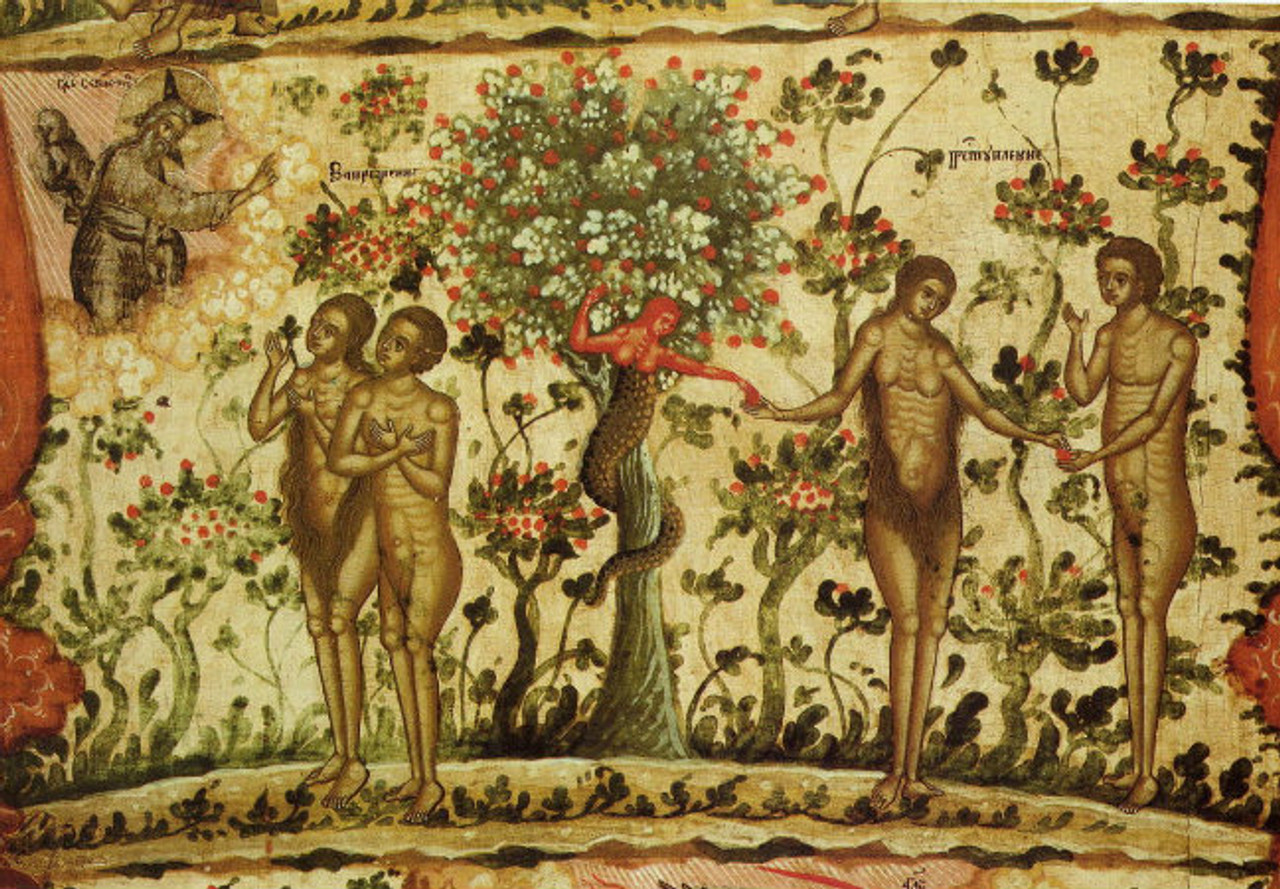
The Marcionite critique does not require the inversion of Genesis into an alternative Gnostic myth. The Church does not venerate the serpent as a savior, identify disobedience with salvation, or teach that eating from the tree constituted humanity’s first true enlightenment.
The serpent belongs to the literary world of the Genesis narrative and does not replace Jesus Christ as the revealer of divine knowledge. Christ alone reveals God the Father, delivers souls from ignorance, and brings the light of the Gospel into the darkness of the present world.
Likewise, the Church does not teach that humanity was saved through the violation of a divine command. Sin is real. It consists in unbelief, hatred, cruelty, exploitation, sexual immorality, idolatry, pride, and resistance to the Holy Spirit. Freedom from the Mosaic Law is not freedom from the Law of Christ or from the moral demands of the Gospel.
What the Church rejects is the use of the Adam and Eve narrative as the foundation of Christian anthropology. Human souls are not personally guilty because of an ancestral act committed by the first couple in Genesis. Each soul is judged according to its own response to grace, faith, truth, and the operation of the Holy Spirit.
The Church therefore rejects inherited guilt while retaining the reality of sin and human bondage. Humanity requires salvation not because every person bears the legal guilt of Adam, but because souls exist within a corruptible world, are subjected to fleshly weakness and lower powers, and themselves participate in sin.
The narratives of the Flood and the Tower of Babel likewise belong to the religious literature of the Hebrew Bible rather than to the Christian Gospel. The destruction of nearly all life by flood cannot be attributed to the character of God the Father revealed through Jesus Christ.
The Father sends His Son to save rather than to destroy. Christ reveals mercy, forgiveness, reconciliation, and deliverance from death. The violence attributed to the Genesis deity reflects the judgment, instability, and coercive rule of the lower order, together with the theological imagination of the human authors who transmitted the narratives.
The Tower of Babel story similarly presents linguistic and cultural diversity as the result of a divine act of disruption. Christian unity, by contrast, does not arise through forced cultural uniformity or earthly empire. It arises through the Gospel, which joins persons of every nation, language, sex, and social condition in one body under Christ.
Genesis also reflects ancient social assumptions concerning hierarchy between male and female. The Marcionite Church does not derive the spiritual subordination of women from the formation of Eve after Adam, nor does it teach that the pains and burdens imposed upon women constitute an eternal divine ordinance.
The Apostle declares that in Christ there is neither male nor female as a distinction of spiritual worth. Men and women possess the same kind of soul, receive the same Holy Baptism, Holy Chrismation, and Holy Communion, and are offered the same salvation through faith in Jesus Christ.
Apelles continued and developed the Marcionite critique of Genesis through his Syllogisms. The surviving fragments show him examining the narratives by reason and exposing statements that he regarded as inconsistent with divine wisdom, justice, and foreknowledge.
He questioned the coherence of issuing a command to Adam if its violation was already foreknown, the physical plausibility of the ark narrative, and the suggestion that the fruit of a tree could confer a power greater than the divine breath already given to humanity. These arguments did not attempt to construct a rival Genesis myth. They demonstrated instead that the Hebrew narratives could not be accepted uncritically as a perfect revelation of God the Father.
The force of this critique compelled defenders of Genesis to answer the Marcionite position directly. The origins of the world, the authority of the six-day creation narrative, the nature of matter, and the identity of the powers responsible for the visible order became major subjects of controversy within the early Church.
In De viris illustribus, Jerome notes that two Christian writers, Appion and Candidus, composed a joint treatise specifically to defend the six-day creation narrative of Genesis against the teachings of Marcion. Their response demonstrates the prominence of the Marcionite critique and the seriousness with which opposing Christians regarded its challenge to the traditional interpretation of creation.
The controversy was therefore not merely about whether the days of Genesis should be interpreted literally or allegorically. It concerned the deeper question of whether the deity and creative activity described in Genesis could be identified without distinction with God the Father revealed through Jesus Christ. Marcion and Apelles answered that question by judging the Hebrew narratives in the light of the Gospel rather than interpreting the Gospel through Genesis.
The critical method associated with Apelles remains useful to the Church. Claims concerning God must be judged in the light of Jesus Christ, the Evangelicon, the Apostle, reason, and the known character of God the Father. No ancient narrative should compel Christians to attribute ignorance, jealousy, regret, deception, cruelty, or ethnic partiality to the Father revealed by Christ.
The rejection of Genesis as Christian Scripture does not require contempt for the natural world or for embodied life. Matter remains the work of God in its ultimate origin. The body, though fleshly and corruptible, is a real vessel of the soul and may be treated with dignity, discipline, and care.
Beauty within nature is also real. The visible world preserves traces of order because the lower powers themselves ultimately exist beneath the Logos. Its beauty, however, is mixed with suffering, predation, disease, aging, decay, and death. It is neither the perfect kingdom of God nor an entirely evil illusion.
Christ does not come merely to explain how the lower world was formed. He comes to rescue souls from its dominion. The Gospel is not a continuation of Genesis, nor is it a new law for preserving the authority of the lower ruler. It is a revelation from above.
God the Father sends Christ into a world that did not know Him. Christ reveals the previously unknown Father, triumphs over the principalities and powers, defeats sin and death, and translates the faithful from the power of darkness into His kingdom.
The true Christian beginning is therefore not the command, “Let there be light,” spoken within the Genesis narrative, but the eternal reality of the Word who was with God before the world and through whom all things ultimately consist.
The true Christian creation is not confined to a six-day sequence. It includes the heavenly and invisible order, the creation of matter, the formation of souls, the existence of the lower powers, and the later fashioning of the visible cosmos through deferred demiurgy.
The true Christian hope is not the eternal preservation of the present fleshly world-system. It is deliverance from corruption, communion with Christ, the salvation of souls, and entrance into the kingdom of God.
The Marcionite Church therefore rejects both fundamentalist Genesis literalism and classical Gnostic inversion. We neither attribute the immediate formation of the visible world to God the Father nor declare matter itself to be evil. We neither identify the serpent as humanity’s savior nor deny the reality of sin.
We confess instead a hierarchical creation. God the Father is the ultimate source of all being. The Logos directly brought forth matter and the heavenly spiritual powers. The lower powers fashioned matter into the visible world. Matter is morally neutral, the present world-order is flawed and corruptible, and every principality and power remains subordinate to Christ.
Genesis may be studied as ancient Hebrew literature, as a record of religious development, and as evidence of how human beings attempted to understand the lower world and its rulers. It may not be imposed upon the Church as the revelation of God the Father or as the foundation of Christian cosmology.
The Marcionite Church begins with Jesus Christ. Through Him we know God the Father. Through Him we understand that the highest reality is not tribal law, earthly dominion, fear, curse, or destruction, but grace, freedom, love, reconciliation, and life.
Our faith therefore looks beyond the Genesis creation myth toward the heavenly and invisible order proclaimed by the Apostle. We confess God the Father above all, Jesus Christ as Lord, the Holy Spirit as the giver of life and sanctification, and the lower principalities and powers as creatures beneath the authority of the Son.
All being ultimately comes from God the Father through the Logos. Matter belongs ultimately to Him. The visible world was fashioned mediately through lower powers. Christ has entered that world to reveal the Father whom it did not know and to deliver souls from corruption into the kingdom of God.