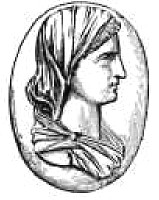




The Marcionite Church is pleased to present the reconstructed Synaxicon, an ecclesiastical collection containing seven epistles received within the Marcionite tradition as the surviving letters of Marcion of Sinope. These are Marcion’s Epistle to the Ephesians, Marcion’s Epistle to the Magnesians, Marcion’s Epistle to the Trallians, Marcion’s Epistle to the Romans, Marcion’s Epistle to the Philadelphians, Marcion’s Epistle to the Smyrnaeans, and Marcion’s Epistle to Metrodorus.
The name Synaxicon comes from the Greek synaxis, meaning a gathering or assembly, joined to the book-title ending -ikon. The title may therefore be understood as “the book that gathers together.” It is an appropriate name for a collection that gathers the epistles, teachings, historical memories, and testimony associated with Marcion’s final ministry and martyrdom.
Marutha of Martyropolis reported that the Marcionites possessed a book called the Saka, a Syriac title conveying the sense of a sum, summary, or completed collection. The Marcionite Church identifies the Synaxicon with this broader tradition of collecting and preserving texts concerning the teachers, martyrs, ministry, and historical life of the ancient Marcionite Church.
The seven epistles survive in the manuscript tradition under the name of Ignatius of Antioch. Several scholars and theologians, including Joseph Turmel, Alfred Loisy, Hermann Detering, and Roger Parvus, have questioned their conventional attribution or argued that the collection contains substantial Marcionite or closely related material. Building upon this body of scholarship, the Marcionite Church reconstructs the seven epistles as letters originally written by Marcion of Sinope shortly before his martyrdom at Rome in 154 C.E.
This reconstruction does not rest upon the discovery of a manuscript bearing Marcion’s name. It proceeds through comparison of the surviving recensions, identification of later interpolations and editorial alterations, restoration of an earlier Pauline theological stratum, and consideration of the historical circumstances reflected within the epistles. The reconstructed Synaxicon therefore represents an ecclesiastical recovery of texts believed to preserve the final pastoral testimony of Marcion beneath their later attribution and transmission.
The epistles are closely associated with the Pauline churches of Anatolia and Syria. Their author writes from Syria and addresses congregations situated along the route from Antioch and Asia Minor toward Rome. Their language is deeply Pauline, drawing repeatedly upon the epistles of the Apostle and addressing the unity, ministry, discipline, worship, and perseverance of the churches.
The author presents himself as a bishop of Syria being conducted westward under guard and expecting to suffer martyrdom at Rome. According to the historical reconstruction received by the Marcionite Church, Marcion returned to the East following his separation from the Church at Rome, exercised episcopal leadership among the Pauline congregations of Syria and Anatolia, and later journeyed again to Rome, where he was martyred in 154 C.E.
Antioch was an important center of early Pauline Christianity and later became a major region of Marcionite activity. The geographical setting of the epistles, their concentration upon the churches of Asia Minor, and their author’s identification with Syria are therefore consistent with the final ministry attributed to Marcion within this reconstruction.
The epistles display several features characteristic of the early Marcionite tradition. They extensively employ Pauline language, sharply distinguish Christianity from Judaism, emphasize the revelation manifested in Jesus Christ, defend the authority of the episcopate, and urge the churches to remain united against hostile teachers and rival theological systems. They contain an early use of the word “Christianity” and contrast the Christian Lord’s Day with the Jewish Sabbath.
The epistles also contain language and imagery resembling the early Christian psalms preserved in the Psalmicon. These parallels connect the Synaxicon with the devotional world of the Greek- and Syriac-speaking Pauline churches in which the psalms circulated and from which Marcion gathered the collection received by the Marcionite Church.
The ecclesiology of the epistles is likewise consistent with Marcion’s need to secure the continuity of the Church before his death. Their repeated exhortations concerning bishops, presbyters, deacons, congregational unity, and obedience may be understood as the final instructions of a church founder preparing his congregations to remain united under their appointed successors.
The Synaxicon preserves the epistles in the order associated with the author’s journey toward Rome. Marcion’s Epistle to the Ephesians exhorts the congregation to unity and perseverance. Marcion’s Epistle to the Magnesians contrasts the new life of Christianity with the old observance of Judaism. Marcion’s Epistle to the Trallians warns against false teachers and division. Marcion’s Epistle to the Romans expresses the author’s expectation of martyrdom. Marcion’s Epistle to the Philadelphians defends the Gospel against Judaizing interpretations. Marcion’s Epistle to the Smyrnaeans concerns the manifestation and suffering of Christ. Marcion’s Epistle to Metrodorus addresses the bishop of Smyrna and commends the ordering and care of the churches.
Within the received manuscript tradition, the final letter is addressed to Polycarp of Smyrna. The Marcionite reconstruction restores its recipient as Metrodorus, the Marcionite bishop of Smyrna and successor of Marcion, who was martyred alongside Polycarp, the Catholic bishop of Smyrna, in 156 C.E. The alteration of the recipient belongs to the wider process by which the epistles were readdressed and attributed to Ignatius.
The multiple surviving recensions demonstrate that the epistles underwent extensive editorial development. The shorter, middle, and longer textual forms contain differences in wording, length, theology, and ecclesiastical emphasis. The Marcionite reconstruction seeks to identify the earlier material beneath these stages of transmission while removing or correcting passages judged to reflect later Catholic interpolation.
The present reconstruction is based especially upon the research of Roger Parvus in A New Look at the Letters of Ignatius of Antioch and Other Apellean Writings. Its English text is principally derived from the translations of J. B. Lightfoot, revised where necessary to reflect the reconstructed recipients, Marcionite terminology, textual judgments, and theological character of the restored collection.
The Synaxicon belongs to the broader textual and ecclesiastical tradition of the Marcionite Church and is included within the Testamentum, the complete codex of Marcionite books. Its inclusion within the Testamentum does not make it Scripture. The epistles of the Synaxicon are neither Canonical nor Deuterocanonical and therefore possess no scriptural authority.
The Synaxicon is received instead as an ecclesiastical and patristic book. Its epistles are valuable for Marcionite theology, liturgy, ecclesiology, discipline, history, pastoral instruction, and the remembrance of Marcion and the saints and martyrs of the ancient Marcionite Church. Their contents are interpreted in conformity with the Canonical Scriptures of the Evangelicon and Apostolicon and the Deuterocanonical Scriptures of the Antilegicon.
The epistles may be used as authorized ecclesiastical readings on appropriate feasts, commemorations, and other liturgical occasions. They may also be cited for theological reflection, historical instruction, pastoral exhortation, and the remembrance of the ancient Church. Such use is ecclesiastical rather than scriptural.
The inclusion of the Synaxicon within the Testamentum preserves an important part of the broader Marcionite textual inheritance without confusing the distinct authority of the books contained within the codex. The Testamentum gathers the Canonical, Deuterocanonical, and ecclesiastical books of the Marcionite Church, while maintaining the proper distinctions among them.
Through the reconstruction of the Synaxicon, the Marcionite Church seeks to recover the final pastoral testimony attributed to Marcion of Sinope and to preserve the memory of the early Pauline churches that continued his ministry. The Evangelicon and Apostolicon remain the Canonical Scriptures, the Antilegicon contains the Deuterocanonical Scriptures, and the Synaxicon serves as an ecclesiastical collection devoted to theology, worship, history, pastoral instruction, and faithful remembrance.