
The Marcionite Church is pleased to present the reconstructed Marcionite Divine Liturgy and the liturgical forms of the Holy Mysteries and Holy Rites, now available in the Litourgicon.
The name Litourgicon is the Church’s Latinized form of the Greek leitourgikon, meaning “liturgical book” or “service book,” from leitourgia, the common worship and service of the Church. Within the Litourgicon, the word liturgy is reserved for the proclamation of the Word and the celebration of the Holy Mysteries, while the word rite is used for the Church’s other sacred observances and for the constituent actions contained within a liturgy.
Because no complete order of ancient Marcionite worship has survived, the forms contained in the Litourgicon are reconstructions. They do not claim to reproduce word-for-word the services celebrated by Marcion of Sinope or by every congregation of the ancient Marcionite Church. They have instead been composed as simple and foundational Pauline forms, reconstructed in keeping with the earliest surviving pre-Nicene forms of Christian worship and ordered according to the doctrine and discipline of the Marcionite Church.
The fixed prayers, hymns, proclamations, and theological content of the liturgies and rites are drawn from, or closely arranged out of, the canonical Scriptures of the Marcionite Church—the Evangelicon and the Apostolicon. The Psalmicon supplies the authorized liturgical psalms. Concise consecratory and ceremonial formulas are used where necessary to express doctrines and practices grounded in the canonical Scriptures and in established Marcionite tradition. The result is a form of worship that is recognizably ancient and Christian while remaining firmly Pauline and Marcionite.
The Marcionite Church distinguishes between three Holy Mysteries and nine Holy Rites. The three Holy Mysteries are Holy Baptism, Holy Chrismation, and Holy Communion. These are the mysteries of Christian initiation: Holy Baptism joins the believer to the death and resurrection of Christ, Holy Chrismation seals the baptized with the Holy Spirit, and Holy Communion completes the believer’s incorporation into the one bread and body of the Church.
The nine Holy Rites are Holy Reconciliation, Holy Matrimony, Holy Anointing, Holy Ordination, Holy Footwashing, Holy Kiss, Holy Veiling, Holy Lovefeast, and Holy Sign. These rites are scriptural blessings, disciplines, and ecclesiastical actions that order and strengthen the Church’s common life. They express repentance, healing, ministry, marriage, humility, fellowship, worship, charity, and devotion, but they are distinguished from the three Holy Mysteries and do not themselves complete Christian initiation.
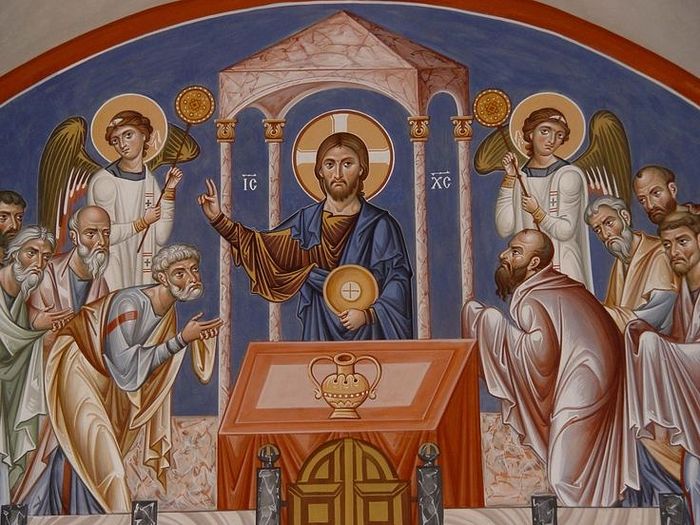
The Litourgicon provides the forms ordinarily required for a believer to enter and complete initiation into the Marcionite Church. It contains the Liturgy of Holy Baptism, the Liturgy of Holy Chrismation, and the Divine Liturgy in which the newly baptized and chrismated receive Holy Communion. No separate rite of First Holy Communion is required. The Divine Liturgy also incorporates Holy Footwashing, the Holy Kiss, Holy Veiling, the rites of the Holy Lovefeast, and the Holy Sign. Together, the orders presently contained in the Litourgicon encompass all three Holy Mysteries and five of the nine Holy Rites.
The reconstructed forms preserve established Marcionite practices, including the Eucharistic fast beginning on Saturday, prayer facing west, the mixed chalice of wine and water, full Trinitarian baptism through three immersions, the post-baptismal anointing with oil, the offering of milk and honey to the newly chrismated, and the permission of a deaconess to baptize a woman. They also preserve the Pauline proclamation of the Evangelicon and Apostolicon, the confession that Jesus Christ is Lord, the invocation of the Holy Spirit, the Holy Kiss, the remembrance of the poor, and the communal Holy Lovefeast.
These forms are intentionally simple and may be celebrated reverently in a church, chapel, private home, or another suitable place. They provide everything necessary for the proclamation of the Gospel and the Apostle, the offering of prayer and thanksgiving, the administration of Holy Baptism and Holy Chrismation, the celebration of the Eucharist, the reception of Holy Communion, and the observance of the Holy Rites contained within them without requiring an elaborate building, choir, or ceremonial establishment.
The Divine Liturgy is not presented as the longest or maximum possible form of Marcionite worship. It is a foundational order upon which the worship of the Church may reverently build. Appropriate psalms from the Psalmicon, additional hymns, prayers, intercessions, readings from the Evangelicon or Apostolicon, supplementary authorized readings, and suitable ceremonial actions may be added according to the season, feast, pastoral needs of the congregation, or established local custom.
Every such addition must remain consistent with the Evangelicon and the Apostolicon, accord with the teaching of the Marcionite Church concerning the Holy Mysteries and Holy Rites, and preserve the orderly and reverent character of Christian worship. Nothing should be added merely for ornament, novelty, or imitation of another tradition. Let all things be done unto edifying, and let all things be done decently and in order.
The Litourgicon is therefore not an attempt to impose a single elaborate ceremonial form upon every congregation. It supplies the Marcionite Church with a clear, scriptural, Pauline, and historically grounded foundation for common worship while allowing that foundation to be expanded reverently as the feasts, seasons, pastoral circumstances, and developing life of the Church require.