


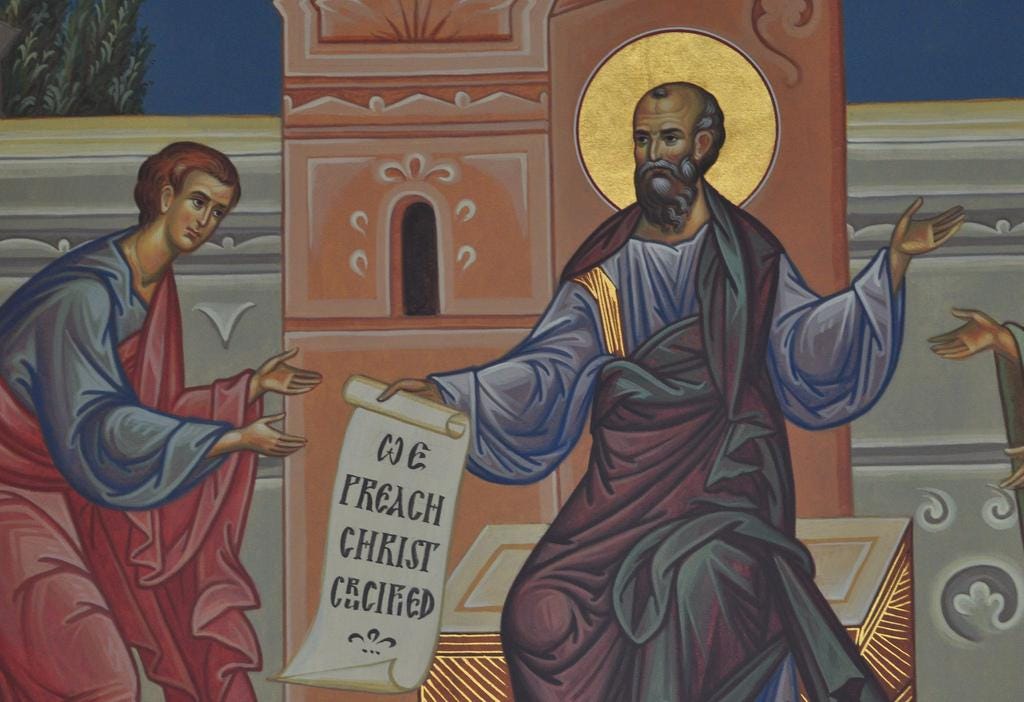

“Now all these things happened unto them without a type: and they are written for our admonition, upon whom the ends of the world are come.”
— 1 Corinthians 10:11
One of the most important readings preserved from the Marcionite Apostolicon occurs at 1 Corinthians 10:11. In the received text, Apostle Paul appears to describe the events that befell Israel as typological. In the Marcionite text preserved through the Dialogue of Adamantius, however, the verse says that these things happened to them “without a type.”
This is not merely a theological inference drawn from Marcionite doctrine. The Dialogue of Adamantius presents the matter as an explicit textual dispute. Adamantius appeals to Apostle Paul in support of the claim that the Law functions as a type or figure of realities later revealed in the Gospel. Marcus responds that this is not how the passage reads in the Marcionite codex. According to the text known to him, the events happened to Israel without a type, although they were still written for Christian admonition.
Eutropius then presses the obvious objection. If the events were not types or patterns, how can they nevertheless serve as instruction to those who read them? Adamantius does not answer by showing that admonition logically requires typology. Instead, he shifts the argument toward textual criticism, accusing Marcionites of removing Pauline passages that contradict their theology and appealing to other statements in Apostle Paul which he believes establish continuity between the Law and the Gospel.
The significance of the exchange lies precisely here. Marcus does not deny that Christians can learn from what happened to Israel. The disputed word concerns whether those events were divinely arranged as prefigurations of Christ. The Marcionite reading separates admonition from typology.
Admonition Is Not Typology
The distinction is straightforward. A historical event can instruct a later generation without having been intentionally designed to symbolize something that would happen centuries afterward.
The punishment of idolaters can warn Christians against idolatry. Rebellion can warn against rebellion. Lust can warn against lust. Murmuring can warn against murmuring. The failures and punishments of an earlier people can become useful examples to anyone who later reads about them.
None of this requires the events themselves to have been prophetic representations of Jesus Christ.
This is the force of the Marcionite reading. Apostle Paul can say that these things were written for Christian admonition while simultaneously denying that they happened as types.
An admonition is a lesson drawn from an event after it has occurred. A type, by contrast, claims that the earlier event was itself ordered beforehand to signify a later reality.
Those are not the same thing.
The distinction preserved in the Dialogue of Adamantius therefore answers Eutropius’s objection directly. Something need not have been created as a pattern in order to become instructive to later readers. History constantly teaches people who were not the original subjects of its events.
The event belongs to the past. The lesson may belong to the present.
Christ Was Not Hidden In The Law
The theology of types became one of the principal means by which later Christianity united the Hebrew scriptures with the Gospel.
Adam became a type of Christ. Isaac became a type of Christ. Joseph became a type of Christ. Moses became a type of Christ. David became a type of Christ. The Passover lamb prefigured Christ. The bronze serpent prefigured the crucifixion. The crossing of the sea prefigured baptism. Manna prefigured Christian spiritual food. The temple, priesthood, sacrifices, festivals, and other institutions of Israel were increasingly interpreted as anticipations of Christian realities.
The Marcionite form of 1 Corinthians 10:11 challenges the premise behind this entire method.
The events that happened to Israel do not need to be converted into a hidden Christian symbolic system. They happened within the religious and historical order of Israel. Christians may later read them and receive admonition from them, but that does not make them secret prophecies of Christ.
This distinction preserves the genuine newness of the Gospel.
Jesus Christ did not descend merely to explain what Moses had already concealed in symbolic form. He came to reveal God the Father.
The Gospel is therefore revelation, not simply the decoding of the Law.
If Christ is already hidden everywhere within the institutions of Israel, then the Gospel becomes less genuinely new. Christ becomes the final interpretation of an older system rather than the bearer of a revelation that had not previously been known.
The Marcionite reading refuses that reduction.
The Argument In Adamantius
The structure of the debate itself is revealing.
Adamantius first uses Apostle Paul to support a typological reading of the Law. Marcus answers not merely by offering a different interpretation, but by appealing to the wording of the Marcionite codex. According to that text, the events happened without a type.
Eutropius then assumes that an event must itself function as a pattern in order to serve as admonition. But that assumption is exactly what the Marcionite reading denies.
A Christian does not need to believe that Israel’s punishment for idolatry was divinely staged as a prophecy of later Christian realities in order to learn from it. The event can remain entirely within Israel’s history and still provide a warning to anyone who reads about it.
Adamantius’s subsequent response is also telling. Rather than demonstrating that admonition necessarily depends upon typology, he attacks the integrity of the Marcionite text and begins appealing to other Pauline passages which he believes connect the Gospel to the Law.
The debate therefore turns from the meaning of one verse into a larger struggle over Apostle Paul himself.
Does Paul teach that the Law contained Christ in advance?
Or does Paul distinguish the old order from the revelation now made known through the Gospel?
The Marcionite reading of 1 Corinthians 10:11 gives an unmistakable answer to the narrower question. The events happened without a type.
The Passover Was The Passover
Typology tends to begin with Christian conclusions and then read those conclusions backward into older texts.
The Passover lamb becomes Christ. The blood on the doors becomes the blood of Christ. The crossing of the sea becomes baptism. Manna becomes Christian spiritual food. The rock becomes Christ. The temple becomes Christ or the Church. The high priest becomes Christ. Sacrificial blood becomes the Cross.
Once this method is accepted, nearly every feature of Israel’s religion can be assigned a later Christian meaning.
But the Marcionite reading allows the earlier events to remain what they originally were.
The Passover belonged to Israel. The sacrifices belonged to Israel. The wilderness belonged to Israel. The Law belonged to Israel. Their institutions and histories belonged to their own covenantal order.
Christ does not need to be inserted backward into every one of them.
The fact that Christians can later learn from these histories does not transform them into prophetic symbols.
That is precisely the distinction Marcus preserves.
They happened to them without a type.
They were nevertheless written for our admonition.
The Problem With Finding Christ Everywhere
Typological interpretation is often presented as a way of honoring Christ by discovering him throughout the Hebrew scriptures.
But there is a theological cost.
If Christ is already hidden in every sacrifice, priesthood, deliverance, sacred object, and major figure of Israelite history, then the Gospel increasingly becomes the completion of a system already in place.
Christ becomes the culmination of Moses.
The Gospel becomes the mature form of the Law.
The revelation of God the Father becomes the fuller explanation of a deity already known.
From a Marcionite perspective, that reverses the direction of revelation.
Christ did not descend merely to uncover Christian meanings hidden beneath Israelite institutions. Christ came to reveal the Father.
Apostle Paul’s Gospel likewise rests upon revelation. Its authority does not depend upon proving that Christian theology had been encoded in Israel’s religion centuries earlier.
That is why the word “without” carries so much theological force.
It denies that the old order must be reconstructed as a vast system of anticipatory Christian symbolism.
Admonition Without Prefiguration
The objection voiced by Eutropius deserves particular attention because it expresses an assumption that remains common in Christian interpretation: if an old event teaches a Christian truth, then it must have been intended to prefigure that truth.
But that conclusion does not follow.
A war may warn later generations about ambition without having been divinely arranged as a symbol of their own political struggles. A ruler’s downfall may teach later readers about pride without having been designed as a prophetic image of another king. A historical disaster may become a moral warning without having been staged as an allegory.
So too with the history of Israel.
Its events can be read.
Its failures can be considered.
Its punishments can warn.
Its stories can admonish.
None of this proves that Christ was secretly embedded within those events from the beginning.
The Marcionite reading preserves a sober distinction between learning from history and turning history into prophecy.
Reading The Old Scriptures Without Christianizing Them
This reading also imposes a useful discipline upon interpretation.
A lamb is not automatically Christ.
Water is not automatically baptism.
Bread is not automatically the Eucharist.
A priest is not automatically Christ.
A king is not automatically Christ.
A piece of wood is not automatically the Cross.
A resemblance perceived by a later interpreter does not establish that the earlier event was intentionally created to predict the later one.
Without such restraint, typology can become almost limitless. The reader can continually discover Christian meanings in details that the original narrative gives no reason to regard as Christian.
The result may demonstrate ingenuity, but ingenuity is not the same thing as revelation.
The Marcionite reading of Apostle Paul provides a boundary. The old histories may admonish Christians without becoming Christian prophecy.
Apostle Paul And The Law
The larger debate in Adamantius shows why this textual variant mattered so much.
Adamantius later appeals again to 1 Corinthians 10, especially the language about Israel passing through the sea, receiving spiritual food and drink, and drinking from the rock identified with Christ. He uses the passage to argue that Apostle Paul himself proclaimed Christ from the Law.
That is precisely the kind of reading against which the Marcionite form of verse 11 pushes back.
Even where Apostle Paul employs spiritual language when discussing Israel, the conclusion does not automatically follow that Israel’s entire history was constructed as Christological prefiguration.
The Marcionite text insists upon the contrary principle: these things happened without a type.
The spiritual lesson belongs to the Christian reader.
That does not mean the original event was secretly Christian.
The Gospel Does Not Need Moses To Authenticate Christ
Typology ultimately raises a question about where the Gospel receives its authority.
If Christ must first be found hidden throughout the Hebrew scriptures, then Moses effectively becomes a witness required to authenticate Jesus.
Marcionite Christianity reverses that priority.
Moses does not authenticate Christ. Christ reveals God the Father.
The sacrificial system does not authenticate the Cross. The Gospel gives the saving work of Christ its meaning.
Israel’s priesthood does not authenticate Christ’s authority. His authority comes from the Father who sent him.
The Hebrew scriptures do not confer legitimacy upon Apostle Paul. His Gospel is received by revelation.
This does not mean that older scriptures contain nothing useful to a Christian reader. Apostle Paul himself says that the events were written for admonition.
But usefulness is not typology.
Resemblance is not prophecy.
Instruction is not prefiguration.
Upon Whom The Ends Of The World Are Come
The final words of 1 Corinthians 10:11 turn the reader forward: “upon whom the ends of the world are come.”
The emphasis is on an ending and a new revelation.
Christ has appeared. The Father has been revealed. The Gospel has gone forth to the nations.
The Christian therefore need not continually return to the former order in search of hidden Christological meanings.
The old histories may still admonish us.
But admonition is not typology.
A later lesson does not prove an earlier prophecy.
The Dialogue of Adamantius preserves the disagreement with unusual clarity. Adamantius appeals to Apostle Paul in defense of typology. Marcus responds that the Marcionite Apostolicon does not say that the events happened as types, but that they happened without a type. Eutropius questions how something non-typological could nevertheless provide admonition, and the Marcionite answer is already contained in the verse itself: events can instruct later readers without having been created as prophetic patterns for them.
That distinction should remain central.
The events happened to them.
The admonition was written for us.
The two statements do not require the events themselves to have prefigured Christ.
The histories may teach us without having predicted us.
The old scriptures may admonish us without secretly containing our Gospel.
Christ was not hidden in the Law waiting to be discovered through typology.
He came to reveal what had not been known.