


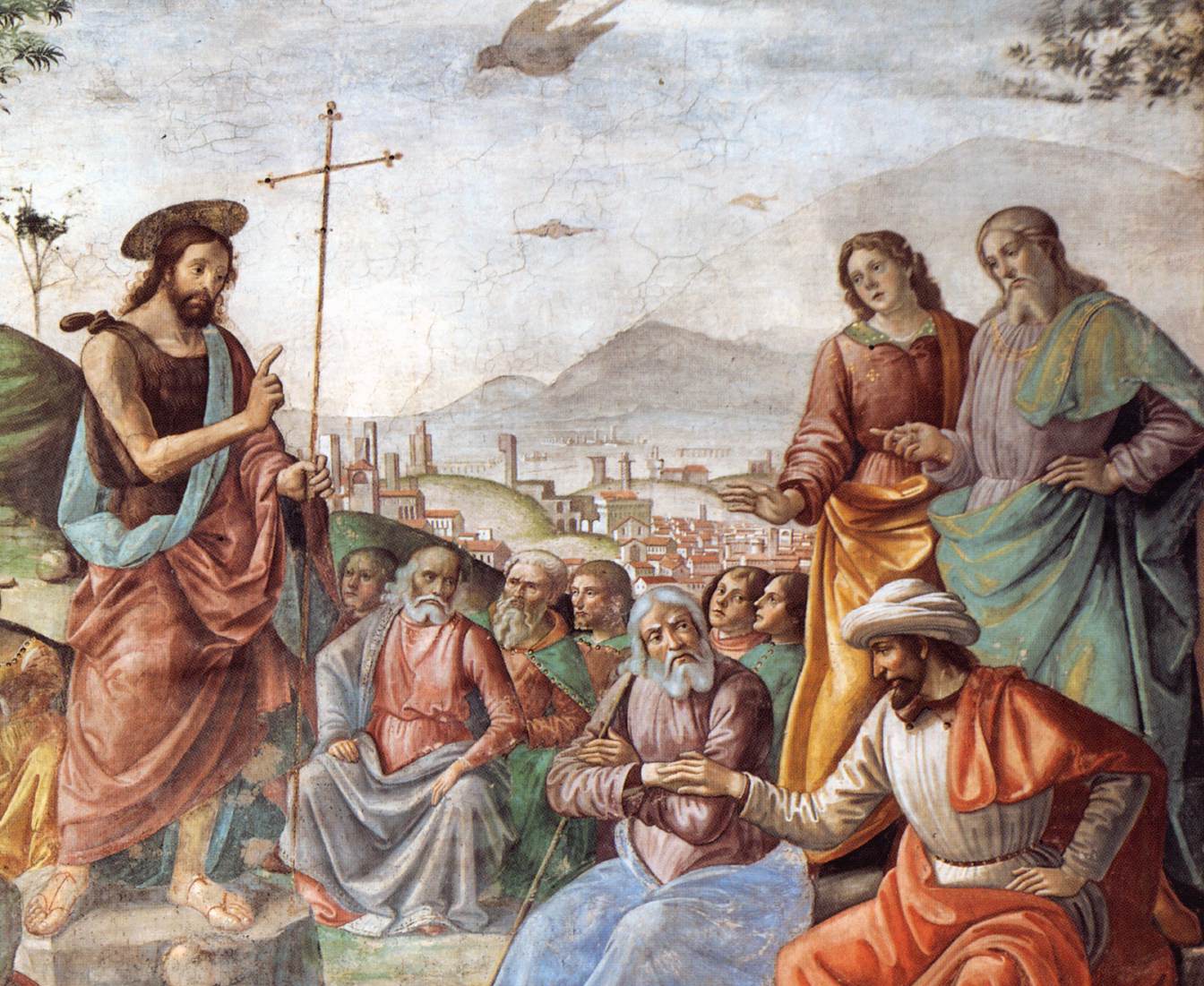

In the Evangelicon, John the Baptist appears as the divinely sent forerunner and prophet, the first true prophet of Christ’s testament, who prepares, bears witness, and then yields the stage to Christ. He stands as an earthly witness at the moment of heavenly arrival: “There was a man sent from God, whose name was John… He was not that Light, but was sent to bear witness of that Light” (Evangelicon 1:6–8), and “John bare witness of him” (Evangelicon 1:15).
We also state plainly what we confess: John is not a prophet of the false deity known as Yahweh, but a prophet of the true God, the Father, who sent Christ. His witness belongs to the Father’s saving revelation and is utterly independent of Judaic prophecies, rites, rituals, and scriptures.
John witnesses the heavenly descent, “Jesus descended out of heaven into the Galilean city of Capernaum” (Evangelicon 2:3), serves as a forerunner rather than a foundation, and finally delivers his disciples unto Jesus before sealing his testimony in martyrdom. Remarkably, this last understanding is not merely a modern inference from the Evangelicon. Ephrem the Syrian preserves an ancient Marcionite explanation of John’s final act: knowing that his death drew near, John sent his flock through two under-shepherds unto Christ, “the Lord of the flock.” The surviving Marcionite interpretation therefore presents John’s final mission not as abandonment of his testimony, but as its consummation.
Mainstream Gospel Narrative
In the mainstream Gospels, John both prepares and—especially in the Synoptics—inaugurates Jesus’ public ministry through the Jordan baptism (Matthew 3:13–17; Mark 1:9–11; Luke 3:21–22). Luke supplies birth narratives and a kinship link between the families (Luke 1–2). Elias typology is explicit: John comes “in the spirit and power of Elias,” and Jesus identifies him as the Elias who was to come (Luke 1:17; Matthew 11:14; 17:10–13; cf. John 1:21).
In the mainstream Gospels, John’s knowledge of Jesus is mixed: early recognition sits alongside what may appear as later uncertainty (Matthew 3:14; 11:2–3; Luke 1–2; 7:18–20; John 1:29–34). These narratives generally place John within Hebrew-Scripture fulfillment and Second Temple continuity—as a prophet of the false deity known as Yahweh.
The Marcionite tradition presents a fundamentally different understanding. John does not derive his authority from Hebrew prophecy, nor does Christ receive His authority or commission from John. John bears witness unto One who descends from above, and when his own ministry approaches its end, he delivers his flock unto Christ.
John the Baptist in the Evangelicon
In the Evangelicon, the delineation is sharp: the narrative opens with Jesus descending out of heaven into Capernaum (Evangelicon 2:3), and there is no nativity, no genealogy, no baptism of Jesus by John, and no kinship or meeting between them narrated. Christ appears and acts on the authority of the Father.
John, for his part, is not tied to prophecies from the Hebrew Bible and stands outside the frameworks, institutions, and typologies of Second Temple Judaism—no Elias identification, no “voice in the wilderness” formula, no priestly lineage, no temple setting.
Instead, he consistently bears witness to the One from above. He recognizes the heavenly origin: “He that cometh from above is above all”; rejoices as the Bridegroom’s friend; and confesses, “He must increase, but I must decrease” (Evangelicon 2:74–76; cf. 2:77; 1:6–8; 1:15).
His words concerning increase and decrease provide the key to his entire office. John has a genuine ministry, disciples, baptism, preaching, and testimony, but none of these terminates in John himself. His office is transitional. He gathers a flock, prepares it, bears witness unto Christ, and finally relinquishes it unto the One to whom it truly belongs.
Accordingly, in Marcionite confession, John is the Father’s prophet, not a prophet of the false deity known as Yahweh; his baptism is “from heaven,” and his testimony accords with the Father’s witness to the Son (Evangelicon 5:29–30; 7:34–35; 18:4).
John’s Preaching and Baptism
John’s ministry is real and weighty. He calls to repentance—“O generation of vipers… the axe is laid unto the root… every tree… is hewn down, and cast into the fire” (Evangelicon 2:82–85)—and the response divides the public: “All the people, and the publicans, justified God… but the Pharisees and lawyers rejected the counsel of God” (Evangelicon 5:29–30).
In the Evangelicon, however, Jesus’ ministry is not inaugurated by a baptism from John. John’s baptism marks preparation and judgment, not Christ’s commissioning. Christ descends from heaven already possessing the authority of the Father.
This distinction is essential. John does not make Jesus the Christ. He does not impart the Spirit unto Him. He does not commission Him. John instead recognizes and bears witness unto the One whose authority is from above.
Thus even John’s baptism ultimately points beyond itself. When Christ asks whether “the baptism of John” was “from heaven, or of men?” (Evangelicon 18:4), the question affirms that John’s ministry possesses heavenly authorization while nevertheless distinguishing that ministry from the greater revelation manifested in Christ.
The Transition of Practices: Fasting and Prayer
The transition from forerunner to Christ occurs through practice rather than through a baptismal rite. Fasting gives way to the Bridegroom’s presence and “new wine” (Evangelicon 3:53–57). The narrative then marks a decisive hinge: “The law and the prophets were until John: since that time the kingdom of God is preached” (Evangelicon 14:16–17).
John therefore stands at a boundary. His ministry points forward, but the preaching of the kingdom belongs properly to the age inaugurated by Christ.
The same transition appears in prayer. When the disciples ask, “Lord, teach us to pray, as John also taught his disciples,” Jesus gives them His prayer (Evangelicon 10:2–4). John had disciples and taught them; Christ now receives disciples and gives the definitive instruction.
These transitions—fasting, prayer, proclamation, and discipleship—all exhibit the same movement: John decreases and Christ increases.
The Prison Inquiry and the Transfer of John’s Flock
As John’s course approaches its end, he sends two disciples from prison: “Art thou he that should come? or look we for another?” Jesus answers with deeds: “the blind see… the dead are raised… to the poor have good tidings been announced,” and adds the beatitude. After the messengers depart, He publicly calls John “more than a prophet,” yet declares, “he that is least in the kingdom of God is greater than he” (Evangelicon 5:19–23; 5:26; 5:28).
Read in isolation, the question sent from prison might be interpreted as uncertainty on John’s part. But an extraordinary ancient witness preserves how Marcionites themselves understood the episode.
Ephrem the Syrian, in his polemic against Marcion, reports their explanation:
“Because John was near to die, he sent his flock by the hand of two under-shepherds to the Lord of the flock.”
—Ephrem the Syrian, Against Marcion II, in C. W. Mitchell, S. Ephraim’s Prose Refutations of Mani, Marcion, and Bardaisan, vol. II, p. 106.
This testimony is particularly important because F. C. Burkitt, in his introductory study of Ephrem’s anti-Marcionite writings, identifies this passage as one of the relatively few places in which Ephrem directly preserves Marcionite exegesis. The Syriac construction used by Ephrem marks the statement as something “they say”—that is, a reported Marcionite answer rather than merely Ephrem’s own characterization of their doctrine.
The interpretation is striking.
John is a shepherd. His disciples constitute his flock. The two whom he sends are his “under-shepherds.” Christ is “the Lord of the flock.”
John therefore does not send the disciples because he has ceased to know the One to whom he had borne witness. Rather, “John was near to die.” His earthly ministry is ending, and the shepherd must dispose rightly of those entrusted unto him. He therefore sends his flock unto its true Lord.
The prison inquiry consequently becomes the consummation of John’s ministry. The question placed upon the lips of the two disciples occasions Christ’s manifestation through His works and permits those disciples to encounter for themselves the One unto whom John has borne witness.
The ancient Marcionite interpretation thus gives concrete meaning to John’s confession:
“He must increase, but I must decrease.”
John’s decrease is not failure. It is fulfillment.
He has gathered a flock, taught it, baptized it, and prepared it. When death approaches, he does not seek to preserve a separate following around his own name. He sends those entrusted unto him unto Christ. The under-shepherds and the flock pass unto “the Lord of the flock.”
This also explains why Christ praises John only after the messengers have departed. John has completed his work. Christ can therefore testify concerning the one who had testified concerning Him: John is “more than a prophet,” yet even the least in the kingdom of God belongs to that greater order which John’s ministry served to announce.
The preserved Marcionite saying consequently provides an ancient interpretive key to the entire Johannine sequence in the Evangelicon: John prepares; John bears witness; John decreases; Christ increases; and finally John delivers his flock unto its Lord.
Lamp and Greater Witness
Christ honors John as “a burning and a shining light,” but immediately establishes the proper hierarchy of testimony: “I receive not testimony from man,” pointing instead to His works and to the Father’s witness (Evangelicon 7:31–35).
There is no contradiction between Christ honoring John and refusing dependence upon human testimony. John truly bears witness, but Christ’s identity does not rest upon John’s authority. John is the lamp; Christ is the One unto whom the lamp points. John is the shepherd; Christ is “the Lord of the flock.”
This distinction again preserves the proper order. John’s testimony is genuine because it accords with the Father, but the Son requires no human being to confer legitimacy upon Him. His works and the Father bear the greater witness.
John therefore occupies an exalted but subordinate office. His greatness consists precisely in faithfully directing attention away from himself and unto Christ.
The Authority Challenge in the Temple
In the temple controversy, Christ leverages John’s public credibility to expose hostile leaders: “The baptism of John, was it from heaven, or of men?” When they refuse to answer, He replies, “Neither tell I you by what authority I do these things,” and warns of the stone that breaks or grinds those who stumble (Evangelicon 18:4–9).
The episode demonstrates the difficulty faced by Christ’s opponents. If they acknowledge that John’s baptism came from heaven, they must reckon with the testimony borne by John. If they deny it, they expose themselves before the people who received John as a prophet.
John’s authority therefore remains subordinate but useful testimony. The forerunner has departed, but his witness continues to condemn those who rejected the counsel of God.
Herod’s Perplexity and John’s Martyrdom
The court first registers perplexity—“John have I beheaded: but who is this?”—and the beheading follows, sealing John’s witness in blood (Evangelicon 8:7–9; 8:10–22).
The ancient Marcionite interpretation preserved by Ephrem gives the martyrdom additional significance. John had already anticipated his approaching death. Before the shepherd was slain, he had sent his flock away from himself and unto Christ.
His martyrdom therefore does not leave his disciples without a shepherd. John has already directed them to “the Lord of the flock.”
His footprint in the Evangelicon is intentionally limited. He prepares, bears witness, delivers his flock, and departs. His death completes the decrease that he himself proclaimed, while the Gospel turns increasingly toward the ministry of Christ.
John as the Pattern of the Forerunner
Taken together, the Evangelicon and the surviving ancient Marcionite interpretation present a remarkably coherent portrait of John.
John possesses genuine heavenly authority, but he is not Christ.
John has disciples, but they ultimately belong to Christ.
John teaches prayer, but Christ gives the greater prayer.
John practices fasting, but the Bridegroom brings the new wine.
John baptizes, but Christ does not receive His commission through John’s baptism.
John bears witness, but Christ possesses the greater witness of His works and of the Father.
John gathers a flock, but Christ is “the Lord of the flock.”
And John decreases so that Christ may increase.
The greatness of John therefore lies not in establishing an independent dispensation, nor in connecting Christ to the Hebrew Scriptures, but in recognizing the heavenly One and surrendering everything entrusted unto him when his appointed work is finished.
Conclusion
John the Baptist is the Father’s prophet—the divinely sent forerunner and the first true prophet of Christ’s testament—who prepares, bears witness, and delivers his disciples unto Christ. Jesus acts with the Father’s authority, receives no authority from John, and is vindicated by His works and by the Father.
The ancient Marcionite interpretation preserved by Ephrem makes this portrait still clearer. When John knew that his death was near, the Marcionites said, “he sent his flock by the hand of two under-shepherds to the Lord of the flock.”
Those few words preserve an important fragment of ancient Marcionite exegesis. John’s prison inquiry is not the repudiation of his earlier witness, but its final pastoral act. The shepherd knows that his ministry is ending. He therefore sends those entrusted unto him unto the One to whom they ultimately belong.
John’s own confession becomes the summary of his ministry: “He must increase, but I must decrease.”
And so he does.
The forerunner prepares. The witness testifies. The shepherd delivers his flock. The martyr seals his testimony. Thereafter the Evangelicon’s focus rests upon Jesus Christ, the Lord of the flock, who descended out of heaven and stands revealed (Evangelicon 2:3).