


Kenosis is a Greek word meaning “emptying.” In Christian theology, it is used especially in connection with the Apostle Paul’s words in Philippians, where he teaches that Jesus Christ, though being in the form of God, humbled himself, took the form of a servant, and became obedient unto death, even the death of the cross.
For Marcionite Christians, kenosis is not the denial of Christ’s divinity, nor is it the denial of his real body, real suffering, or real death. It is the mystery of the Son of God descending from heaven, taking on the likeness of sinful flesh, entering the condition of human weakness, and submitting himself to death for our salvation.
The Apostle writes:
“Let this mind be in you, which was also in Christ Jesus: Who, being in the form of God, thought it not robbery to be equal with God: But made himself of no reputation, and took upon him the form of a servant, and was made in the likeness of men: And being found in fashion as a man, he humbled himself, and became obedient unto death, even the death of the cross.”
Philippians 2:5–8
This is the foundation of Marcionite kenosis. Christ did not cease to be divine. He did not surrender his Sonship. He did not become a mere man. Rather, the Son of God humbled himself by appearing in real flesh, accepting real suffering, and entering the visible world-order ruled by the ‘god of this world,’ so that he might rescue those held under death.
Christ Descended from Heaven
Marcionite Christianity begins not with Bethlehem, but with the descent of Christ from heaven. The Evangelicon declares:
“Jesus descended out of heaven into the Galilean city of Capernaum, a city near the sea, in the borders of Zabulon and Nephthalim. Having taken on the appearance of a man, he appeared thirty years of age and was teaching in the synagogue on the Sabbath days.”
Evangelicon 2:3–4
This descent is essential. Christ is not a prophet raised up from the lower order. He is not a man later adopted into divine favor. He is not a child produced through the fleshly system of generation. He is the Son of God sent by God the Father, descending from above into the world below.
Yet this descent does not mean that his body was false, unreal, or illusory. The Marcionite Church rejects the accusation that Christ was a phantom. He truly appeared in the flesh. He truly suffered. He truly bled. He truly died. His body was not the product of ordinary human birth, but it was nevertheless a real body, capable of hunger, weariness, pain, and death.
The distinction is this: Christ’s flesh was real, but it was not derived from the lower biological order. His body was divinely given for the work of redemption.
Not Docetism
Marcionite Christology is often accused of docetism. This accusation must be rejected.
Docetism teaches that Christ only seemed to have a body, only seemed to suffer, and only seemed to die. Marcionite Christianity does not teach this. The Gospel is not a drama of illusion. The cross is not a symbol without blood. The Passion is not a theatrical appearance. Christ entered the condition of flesh truly enough to suffer death, yet without being generated by the lower order of corruption.
Paul teaches:
“For what the law could not do, in that it was weak through the flesh, God sending his own Son in the likeness of sinful flesh, and for sin, condemned sin in the flesh.”
Romans 7:3
Paul does not say that Christ was sinful flesh. He says that Christ came in the likeness of sinful flesh. This is the Marcionite distinction. Christ truly entered the condition of flesh, but he did not originate from the fleshly order governed by sin, death, and corruption.
His flesh was real. His suffering was real. His death was real. But his origin was heavenly.
The Likeness of Men
Paul says that Christ was “made in the likeness of men” and was “found in fashion as a man.” These words are precise. They do not reduce Christ to a mere human being, nor do they deny the reality of his manifestation. They describe the mystery of heavenly descent.
Christ took the form of a servant. He entered the visible world not as a ruler demanding glory, but as one who served, taught, healed, suffered, and died. Though he was above the powers, he submitted himself to the condition of those beneath the powers. Though he was from God the Father, he entered the realm ruled by the ‘god of this world.’ Though he was life, he accepted death.
This is kenosis.
It is not the loss of divinity. It is the humility of divinity.
The Real Suffering of Christ
Marcionite kenosis requires the real Passion. If Christ did not truly suffer, then he did not truly humble himself. If he did not truly die, then death was not truly overcome. If his body was only an illusion, then his obedience unto death would also be an illusion.
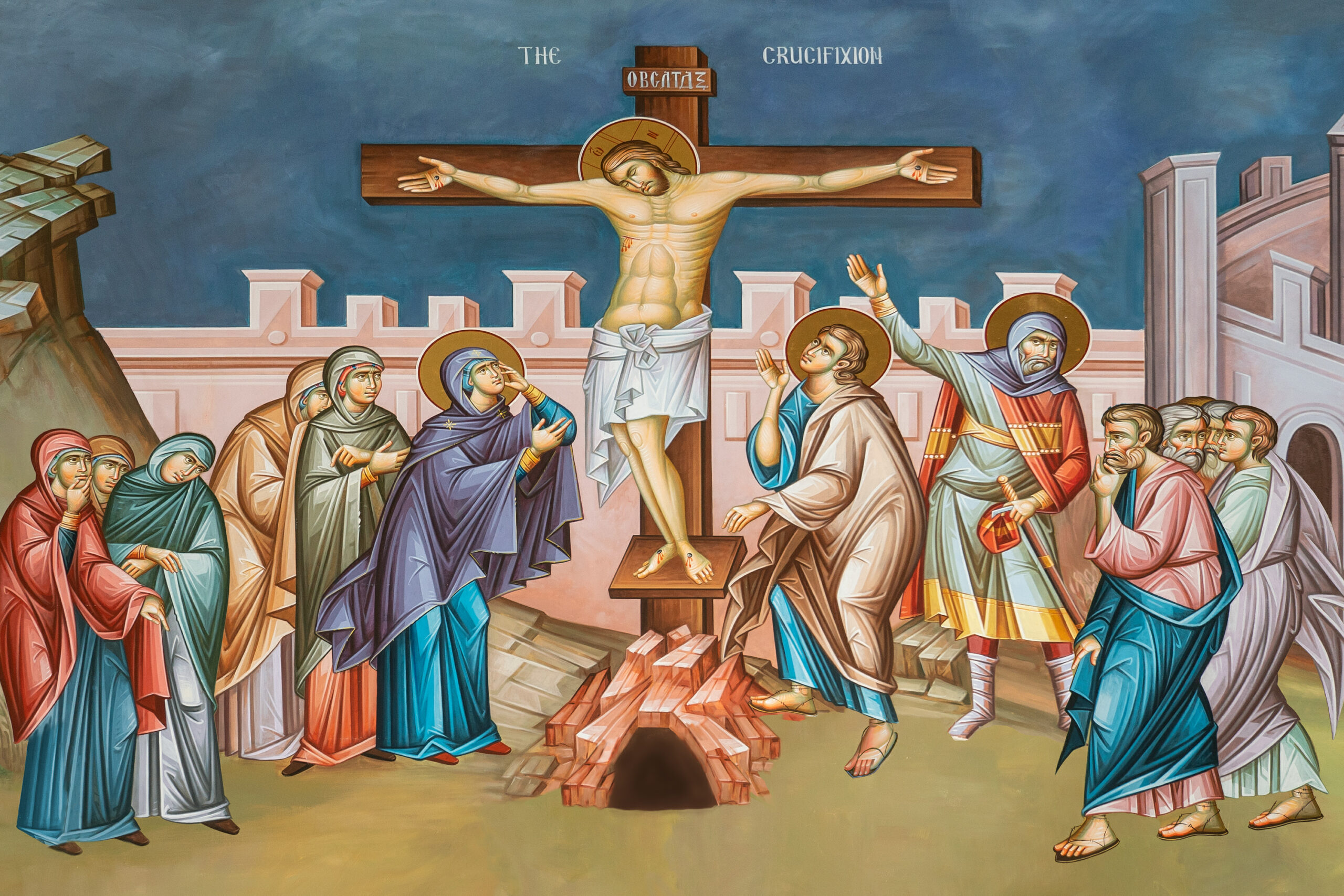
The Evangelicon preserves the Passion of Christ as a true event. Jesus is mocked, crucified, and placed among transgressors. He prays from the cross:
“Then said Jesus, Father, forgive them; for they know not what they do. And they parted his raiment, and cast lots.”
Evangelicon 22:49
This prayer is not the speech of a phantom. It is the mercy of the Son, suffering at the hands of the ignorant powers and those enslaved beneath them. Christ’s kenosis is shown not only in taking flesh, but in forgiving from the cross.
He who came from the Father entered the realm of violence and answered it with mercy.
Kenosis and the ‘god of this world’
The self-emptying of Christ must also be understood cosmologically. Christ descended into a world not ordered according to the goodness of God the Father, but fashioned and ruled under the lower powers. The Apostle speaks of the one who blinds the minds of unbelievers:
“In whom the god of this world hath blinded the minds of them which believe not, lest the light of the glorious gospel of Christ, who is the image of God, should shine unto them.”
2 Corinthians 4:4
Christ’s descent is therefore an invasion of light into a darkened order. The Son does not come as the fulfillment of the Law, nor as the servant of the false deity of the Hebrew Bible, but as the revealer of God the Father. He enters the world of bondage in order to liberate those trapped within it.
This is why kenosis is not merely moral humility. It is also a redemptive descent. Christ comes down from the height of divine glory into the place of weakness, accusation, flesh, and death.
He does not descend because the lower order is good. He descends because those held within it are loved by God the Father.
Kenosis and Deferred Demiurgy
Marcionite theology distinguishes between God the Father as the ultimate source of all being and the lower world-order fashioned by the ‘god of this world.’ Matter itself is not evil. Matter is morally neutral. The evil lies in the corruptible arrangement, fleshly bondage, and death-bearing order imposed upon it by the lower powers.
Christ’s kenosis takes place within this condition. He enters the visible and fleshly world, not because this order is his kingdom, but because it is the place from which he rescues souls. His body is real, but it is not a confession that the present world-order is good. His suffering is real, but it is not submission to the righteousness of the Law. His death is real, but it becomes the means by which death is overcome.
Thus, kenosis does not erase the Marcionite distinction between God the Father and the lower ruler. It confirms it. The Son descends from the Father into the world of the lower powers, humbles himself beneath their violence, and triumphs by the cross.
The Mind of Christ
Paul does not teach kenosis only as a doctrine about Christ. He also commands the faithful to receive the same mind:
“Let this mind be in you, which was also in Christ Jesus.”
Philippians 2:5
The Marcionite Christian is therefore called to imitate the humility of Christ. This does not mean pretending to be weak. It means refusing the pride, violence, domination, and vainglory of this world. The Christian does not overcome the world by becoming more worldly. He overcomes by being conformed to Christ.
Paul continues:
“Wherefore, my beloved, as ye have always obeyed, not as in my presence only, but now much more in my absence, work out your own salvation with fear and trembling.”
Philippians 2:12
Salvation is the gift of God the Father through Jesus Christ, yet the faithful must live in reverence, obedience, and humility. The one rescued by Christ must no longer live as a servant of the lower world-order. He must become a light in the world.
Paul says:
“Do all things without murmurings and disputing: That ye may be blameless and harmless, the sons of God, without rebuke, in the midst of a crooked and perverse nation, among whom ye shine as lights in the world.”
Philippians 2:14–15
Kenosis, therefore, becomes both Christological and ethical. Christ humbled himself for our salvation. We humble ourselves because we have been joined to him.
Against Catholic Misreadings
The Catholic doctrine of the Incarnation teaches that Christ was born through the virgin birth narrative and became fully man according to the ordinary course of human generation, while also being fully God. Marcionite Christianity does not receive that framework as authoritative. The Marcionite Church receives the Evangelicon and Apostolicon as the rule of Christian doctrine, and these testify to the descent of Christ from heaven and his appearance in the likeness of men.
This does not mean that Marcionites deny Christ’s body. It means that we deny that his body originated from the lower order of fleshly generation. We do not confess a merely symbolic Christ, nor an apparition, nor a deceptive phantom. We confess the Son of God truly manifested in flesh, truly crucified, truly dead, and truly victorious.
The Catholic error is to assume that real flesh requires ordinary birth from the lower order. The Marcionite answer is that God the Father can send his Son in real flesh without subjecting his origin to the system of corruption ruled by the ‘god of this world.’
The Kenosis of Holy Communion
There is also a sacramental pattern to kenosis. In Holy Communion, Christ gives his body and blood under humble forms. What appears outwardly lowly becomes the means by which the faithful receive Christ. This is not deception. It is divine humility.
So too in the Gospel, Christ comes not in worldly majesty, but in the form of a servant. He does not descend surrounded by the glory expected by the rulers of this age. He appears in humility, suffers rejection, and gives himself unto death.
The world sees weakness. Faith sees the power of God.
Kenosis and Union with Christ
Christ’s self-emptying is not only an event outside us. It becomes the pattern of life within us. The faithful are called to die to the flesh, to reject the passions of the lower order, and to live in the Spirit.
Paul writes:
“I am crucified with Christ: nevertheless I live; yet not I, but Christ liveth in me.”
Galatians 2:20
This is the Marcionite life. Christ descended to us, that we might ascend in him. He entered death, that we might be freed from death. He humbled himself, that we might be raised. He took the form of a servant, that we might become sons of God.
The self-emptying of Christ becomes the self-emptying of the Christian: not self-hatred, not denial of being, but the surrender of pride, violence, fleshly bondage, and loyalty to the present world-order.
Conclusion
Marcionite kenosis is the doctrine of Christ’s merciful descent. The Son of God, being in the form of God, did not seize worldly glory, but humbled himself. He descended from heaven, appeared in real flesh, took the form of a servant, entered the condition of human weakness, and became obedient unto death, even the death of the cross.
He was not a mere man. He was not a phantom. He was not born from the lower order of corruption. He was the Son of God sent by God the Father, manifested in the likeness of sinful flesh, crucified under the powers of this world, and raised in triumph over death.
Therefore, the Church confesses:
Jesus Christ is Lord, to the glory of God the Father.