


The Discernment of the Spirits of Wickedness and Goodness is received by the Marcionite Church of Christ as a lost theological treatise of Patricius of Rome, known through Augustine of Hippo’s Contra adversarium legis et prophetarum, composed around 420 C.E. The treatise examines the character of the Jewish lawgiver against the supreme goodness of God the Father revealed by Jesus Christ. Its argument joins the antithetical approach of Marcion of Sinope to the syllogistic criticism associated with Apelles.
The Treatise and Its Preservation
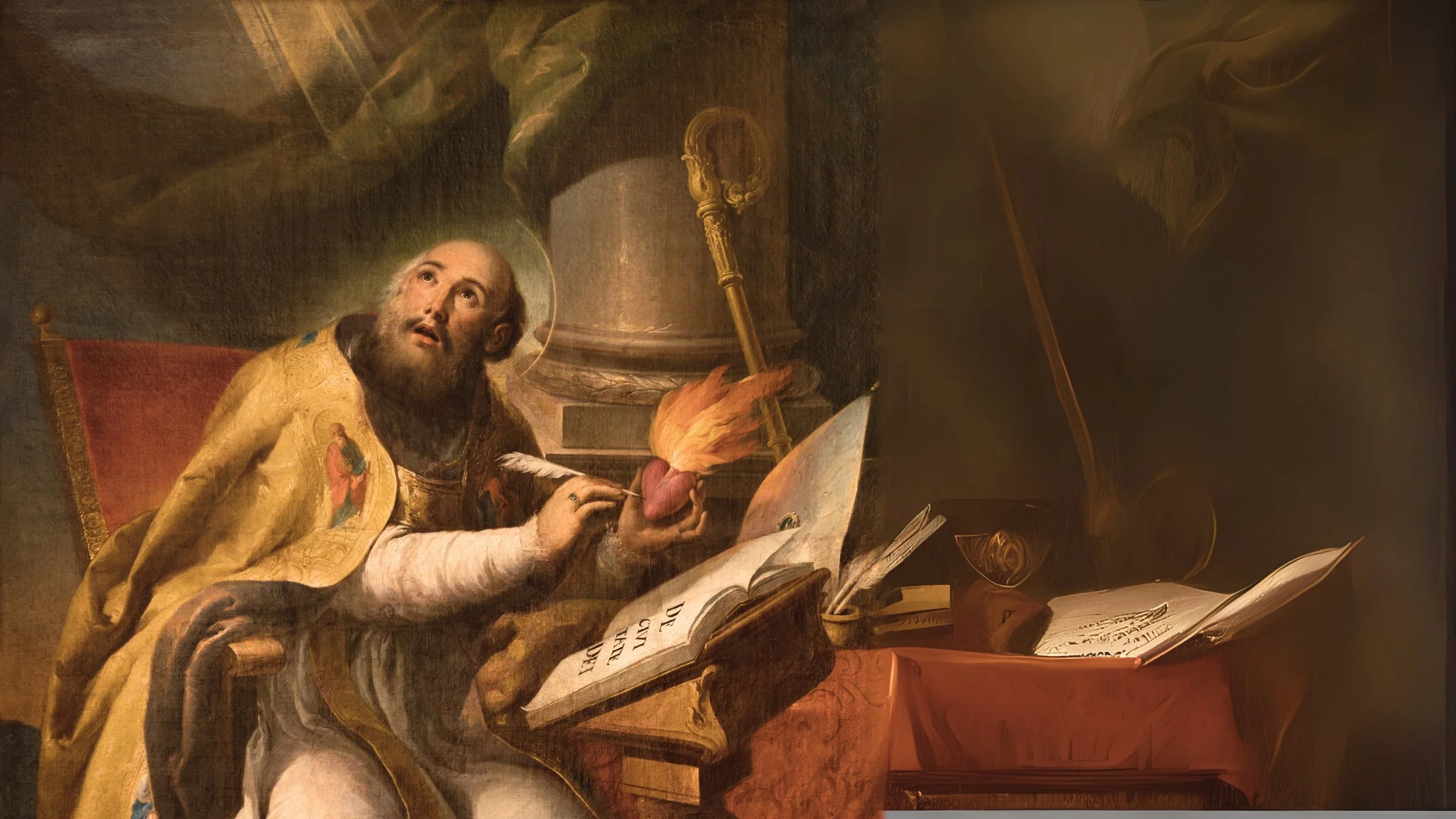
Augustine wrote against an anonymous opponent of the Law and Prophets and subsequently associated the work with Marcionism. The Church identifies its author with Patricius of Rome. The Latin heading Discretio Spirituum Malignitatis et Bonitatis is preserved for the concluding antitheses; the Church employs its English rendering as the title of the reconstructed whole. Augustine’s testimony remains the chief source for the author’s arguments, although his refutation must be distinguished from the opponent’s own words.
Fabricius, Patricius, and the Marcionite Schools
The Church understands Fabricius of Rome as an Apellean teacher and Patricius as his disciple. The first-generation Apellean and Lucanist schools developed differing accounts of the lower powers; the later Severian and Patrician schools developed from the Apellean tradition. The Patricians distinguished God the Father, the supreme Good, from the evil prince of this world, identified with the Jewish lawgiver. This distinction did not make the lower power a coequal, eternal deity. It concerned a subordinate ruler whose character and deeds could be judged by the revelation of Christ.
Antitheses and Syllogisms
Marcion’s Antitheses contrasted the Gospel with the Law. Apelles’ Syllogisms pressed the narratives of the Hebrew scriptures with questions of consistency and reason. The Patrician treatise employs both methods. Its author uses the Hebrew writings extensively against their own theological claims and against Judaizing interpretations of Christianity. Such adversarial citation does not entail receiving those writings as the revelation of God the Father.
Creation and the Ignorance of the Lower Ruler
Patricius challenged the account of creation with questions concerning the beginning, divine inactivity, and the recognition of light. In a Jacobean reconstruction of the argument preserved by Augustine, he asks:
In what beginning? In that wherein god himself began to be, or in that wherein he grew weary of being idle?
— Augustine, Contra adversarium legis et prophetarum I.2.2.
Of the pronouncement that light was good, the argument continues:
So little knew he aforetime what light was, that now, beholding it for the first time, he judged it to be good.
— Augustine, Contra adversarium legis et prophetarum I.7.10.
These questions expose what the author considers the difference between the imperfect knowledge of the world-ruler and the perfect wisdom of God the Father. They also illustrate why the Church does not confuse the ultimate source of being with the subordinate fashioning of the visible world.
Eden, the Serpent, and the Tree of Life
The prohibition of the knowledge of good and evil receives particular criticism. Patricius understands the suppression of discernment as unworthy of the supreme Good, who calls humanity toward truth. He also questions how the serpent could overcome the man fashioned by the ruler:
The serpent is found in a better place than god, because he prevailed to deceive the man whom god had made.
— Augustine, Contra adversarium legis et prophetarum I.17.23.
The account of the tree of life raises a further difficulty:
How then could man, being immortal before the curse, live for ever, seeing he had not yet eaten of that tree?
— Augustine, Contra adversarium legis et prophetarum I.18.24.
These are reconstructed English formulations of arguments transmitted through Augustine, not a complete independently surviving Patrician manuscript. Their significance lies in the author’s insistence that claims of divine authority may be tested through reason and moral discernment.
The Flood and Divine Remembrance
Patricius also challenged the destruction of humanity by the Flood and the subsequent establishment of the rainbow as a reminder:
A forgetful god, whose memory was dead, set a bow in the clouds, which is called Iris, whereby he might be admonished not again to destroy the race of men by a flood.
— Augustine, Contra adversarium legis et prophetarum I.29.43.
The question concerns both the justice of indiscriminate destruction and the apparent need of an omniscient being for a visible reminder. The Patrician conclusion is that such actions cannot disclose the character of the Father revealed by Christ.
The Origin of Evil
Concerning the Jewish lawgiver’s claim to create evil, the treatise argues:
He maketh not evils, but createth them. For if he made them, they would be foreign unto him, and would come unto him from without. But because he createth them, he bringeth them forth from himself, as from the very root.
— Augustine, Contra adversarium legis et prophetarum I.32.49.
The argument concerns the character of the agent who brings forth evil. It does not require evil to be an independent and eternal substance. The Church distinguishes matter, the corruptible world, and the wicked world-order. The Patrician school adopted a particularly severe view of flesh, which Philastrius of Brescia reports it attributed to an evil power; that teaching must not be confused with a universal Marcionite condemnation of matter itself.
The Abolition of Sacrifice
The Evangelicon records the Saviour’s declaration:
I am come to abolish the sacrifices, if ye cease not from sacrificing, the wrath will not cease from you.
— Evangelicon 2:19.
The Church’s present I Corinthians 10:18–20 places the sacrificial fellowship of Israel immediately before the condemnation of sacrifices to devils:
Behold Israel after the flesh: are not they which eat of the sacrifices partakers of the altar?
But I say, that they which sacrifice, sacrifice unto devils, and not unto God: and I would not that ye should have fellowship with devils.
— I Corinthians 10:18, 20.
Unlike the conventional wording expressly naming Gentile sacrifices, this edition reads simply “they which sacrifice.†Patricius applied the condemnation to the sacrificial ordinances of the Jewish Law, and further criticized the appeasement demanded after the plague in David’s reign. The Church understands Christ’s self-offering as the free act of redeeming love, not as a continuation of animal slaughter to satisfy the wrath of God the Father. Marcion’s Homily to Diognetus, as received by the Church, likewise criticizes material offerings attributed to divine need.
The Gospel and the Former Law
The Evangelicon reads:
Think not that I am come to fulfil the law, or the prophets: I am not come to fulfil, but to destroy.
— Evangelicon 14:16.
For the Church this reading articulates the distinction between the former dispensation and the revelation of God the Father. The Saviour’s coming is not the endorsement of every command attributed to the Jewish lawgiver. His revelation is the standard by which those commands are judged.
The Fivefold Pauline Interpretation
Fabricius taught that the Apostle Paul addressed different hearers according to their capacity for divine understanding. Patricius preserves the teaching:
The Apostle spake in five persons, according to the several capacities of men’s understanding. For in making known unto a people yet unlearned the things which are of God, he ought not to begin with the more perfect things, nor, whilst withdrawing them from the customs of their former life, to begin with the more difficult, lest he trouble those yet new unto the faith with the perfect doctrine.
— Augustine, Contra adversarium legis et prophetarum II.2.3.
The five persons are the Jews, those under the Law, those without the Law, the weak, and the perfect. The first four follow I Corinthians 9:19–22; the fifth follows I Corinthians 2:6: “Howbeit we speak wisdom among them that are perfect.†This pedagogy explains why the Apostle might accommodate the language and assumptions of his audience without thereby making every accommodation his final doctrinal statement.
The Holy Spirit and True Prophecy
Patricius declares:
But before the coming of the Saviour, the holy and divine Spirit was not upon the earth.
— Augustine, Contra adversarium legis et prophetarum II.3.9.
The Patrician school thus distinguishes the Jewish prophetic age from the true prophetic ministry inaugurated through Christ. I Corinthians 12:28 appoints “first apostles, secondarily prophets,†which Patricius understood as indicating the order of the Christian prophetic dispensation. The Evangelicon reinforces the distinction when Christ reproaches an appeal to the former prophets:
Ye have forsaken the Living One who is before you, and speak of the dead.
— Evangelicon 9:28–30.
This does not abolish Christian prophecy. I Corinthians 12:10 includes prophecy and the discerning of spirits among the gifts of the Spirit, while I Corinthians 14:29 commands the Church to judge prophetic utterances. The Patrician theology continues the Apellean esteem for new prophecy, but places true prophecy under the revelation of Christ.
The Soul, Blood, and Salvation
Patricius criticized the Mosaic identification of the soul with blood, arguing that the enduring soul cannot be reduced to the mortal substance of the body (Augustine, Contra adversarium legis et prophetarum II.6.21). The distinction serves the hope of resurrection and the liberation of souls through Christ. It does not mean that the soul saves itself by knowledge alone: the revelation and grace of God the Father remain indispensable.
Antichrist and the Lower Powers
The Patrician school also developed a distinctive identification of Antichrist, interpreting the Pauline opposition between Christ and the powers of this world within its wider contrast between the supreme Good and the lower ruler. Its teaching belongs to a broader Marcionite eschatology in which the authority of the prince of this world is temporary and the Kingdom of Christ is victorious. The school did not thereby confess two coequal or co-eternal gods.
The Concluding Exhortation
The final antitheses bring the work’s arguments to an appeal for conversion:
Wherefore then, brother, forsaking the iniquity of our former error, let us turn our minds unto Christ, the true and supreme God, and not unto the prince of this age and maker of the world, wherein we have oftentimes been declared to be strangers and sojourners.
The exhortation also contrasts the Saviour’s call to spiritual understanding with the lower ruler’s prohibition of discernment:
Let us turn our minds unto him who, calling us brethren, exhorted us to watch and to mind divine things; and not unto him who suffered us not even to possess the faculty of discernment.
— Augustine, Contra adversarium legis et prophetarum II.11.36.
The central purpose of discernment is therefore not criticism for its own sake. It is the turning of the soul from ignorance and bondage toward the goodness revealed by Jesus Christ.
Conclusion
The Discernment of the Spirits of Wickedness and Goodness bears witness to the development and survival of Marcionite theological reasoning in late antiquity. In the Church’s reconstruction, Patricius inherited through Fabricius the Apellean use of syllogisms and joined it to the antithetical tradition of Marcion. The resulting theology examines creation, foreknowledge, the Flood, knowledge, sacrifice, the soul, prophecy, and the authority of the Jewish scriptures according to the goodness of God the Father.
The work’s preservation through Augustine’s hostile refutation is itself historically important. The surviving fragments and reports reveal a Christian movement engaged in extensive scriptural argument, Pauline interpretation, and moral criticism rather than merely repeating inherited slogans. Its significance is illuminated by readings in the Church’s Evangelicon and Apostolicon, especially the abolition of sacrifices, the revelation of the previously unknown Father, and the distinction between the former prophets and the Spirit given through Christ.
Above all, the treatise calls the faithful to judge every claim of spiritual authority by the revelation of Jesus Christ. The supreme Good is not known through terror, blood offerings, or the prohibition of understanding, but through the mercy, knowledge, and saving grace of God the Father. To discern the spirits is to recognize this difference and to turn toward Christ in faith, charity, and truth.