


The Marcionite Church teaches plainly that babies, infants, and young children before moral discernment are not born guilty. They do not enter the world stained with Adamic guilt. They do not inherit personal transgression. They do not stand condemned for a sin they did not commit. They are born sinless, and if they die before moral discernment, they die sinless.
This doctrine is not a cold abstraction. It is a word of comfort to parents who have lost a child. The Church does not tell them that their child was born under wrath, nor that their child’s fate is uncertain. The Church teaches that such children belong to the kingdom of God.
The Church distinguishes mortality from guilt. Babies and infants may suffer death because the present world is mortal, corruptible, and subject to bondage, but they do not die as sinners. Death may touch the innocent; guilt does not. The infant who dies has not rejected Christ, despised the Gospel, worshipped falsely, or knowingly chosen evil. Such a child was born without guilt, lived without accountable transgression, and died without personal sin.
For this reason, the Church teaches that babies, infants, and young children before moral discernment who pass from this life ascend immediately to the kingdom of God. They belong to God the Father, not to condemnation. They are not judged as rebels, lawbreakers, or enemies of the Gospel, for they have neither rejected Christ nor knowingly chosen evil.
This is not sentimental doctrine. It is canonical doctrine. The Testamentum bears witness against the later doctrine that infants are born personally guilty before God.
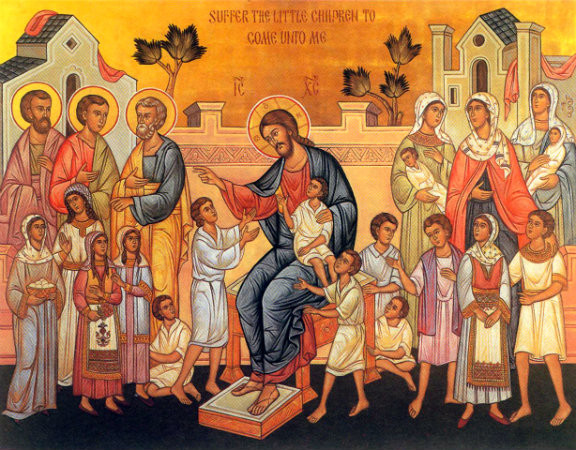
The clearest witness is found in the Evangelicon, when infants are brought to Jesus:
“And they were bringing unto him also the infants, that he should touch them: but when the disciples saw it, they rebuked them. But Jesus called them unto him, and said, Suffer the little children to come unto me, and hinder them not: for of such is the kingdom of God. Verily I say unto you, Whosoever shall not receive the kingdom of God as a little child shall in no wise enter into it.” — Testamentum, Evangelicon 18:15–17
This passage does not describe infants as polluted, guilty, damned, or spiritually dead in Adam. It places them beside the kingdom of God. Christ does not say, “Of such is condemnation.” He does not say, “Of such is inherited guilt.” He says, “Of such is the kingdom of God.”
The meaning is direct. Babies and little children are not examples of rebellion against God. They are examples of the disposition by which the kingdom is received. If the kingdom must be received as a little child, then the little child cannot be treated as the image of inherited damnation.
The Evangelicon also warns against harming or corrupting the little ones:
“Then said he unto the disciples, It is impossible but that offences will come: but woe unto him, through whom they come! It were better for him if he had not been born, or if a millstone were hanged about his neck and he were cast into the sea, than that he should offend one of these little ones.” — Testamentum, Evangelicon 15:1–2
Here again, the guilt is not placed upon the little one. The guilt is placed upon the one who causes offence. The child is vulnerable, guarded, and beloved. The corrupter is condemned; the little one is protected.
The Apostolicon teaches the same principle by grounding judgment in personal moral agency. Paul teaches that judgment concerns sin, law, conscience, and accountable action:
“For as many as have sinned without law shall also perish without law: and as many as have sinned in the law shall be judged by the law; For not the hearers of the law are just before God, but the doers of the law shall be justified. For when the Gentiles, which have not the law, do by nature the things contained in the law, these, having not the law, are a law unto themselves: Which shew the work of the law written in their hearts, their conscience also bearing witness, and their thoughts the mean while accusing or else excusing one another; In the day when God shall judge the secrets of men by Jesus Christ according to my gospel.” — Testamentum, Apostolicon, Romans 2:3–7
This is not a doctrine of blind inherited guilt. It is a doctrine of judgment according to accountable sin. Paul speaks of conscience accusing or excusing. He speaks of those who do or do not sin under law. He speaks of the secrets of men judged by Jesus Christ according to the Gospel. A baby has no such accountable rebellion. An infant has no formed conscience by which he knowingly chooses evil against God. A very young child before moral discernment cannot be treated as a deliberate transgressor of the Gospel.
Paul states the principle even more directly:
“For until the law sin was in the world: but sin is not imputed when there is no law.” — Testamentum, Apostolicon, Romans 4:13
Sin may be in the world. Death may reign in the present order. The flesh may be subject to weakness, mortality, and corruption. But sin is not imputed where there is no law. This destroys the claim that infants are personally guilty merely because they were born. Mortality is not the same thing as guilt. Corruption is not the same thing as personal condemnation. The infant may suffer death because the present world is flawed and perishing, but the infant does not die as a sinner under imputed guilt.
Paul also teaches that judgment is according to what one has done:
“For we must all appear before the judgment seat of Christ; that every one may receive the things done in his body, according to that he hath done, whether it be good or bad.” — Testamentum, Apostolicon, II Corinthians 5:10
Again, the standard is personal action. The judgment seat of Christ is not presented as the condemnation of babies for Adam’s deed. It concerns what each one has done in the body, whether good or bad. Where there is no accountable deed, there is no personal guilt to condemn.
Therefore the Church teaches that infants are sinless, young children before moral discernment are not accountable as sinners, and those who die in such innocence ascend immediately to the kingdom of God. They do not require cleansing from personal guilt, because no personal guilt belongs to them. They do not require release from an Adamic crime they never committed. They are not damned for want of a ritual, nor condemned for a guilt they never incurred. They belong to God the Father.
This does not mean that children remain sinless forever. As a child grows into discernment, conscience awakens, choice becomes morally meaningful, and personal sin becomes possible. The Church therefore distinguishes between infancy and moral accountability. Babies and infants are sinless. Young children before discernment are guiltless. But those who come to know good and evil may become accountable for the evil they knowingly choose.
Nor does this mean that human beings save themselves by innocence or strength. It means only that guilt is not imputed where there is no accountable sin. Salvation is still the gift of God the Father through Jesus Christ. The innocence of infants is not self-redemption; it is the absence of personal guilt.
The world into which children are born is flawed, mortal, and subject to the bondage of corruption. But the child is not evil by substance. The body is not evil by nature. Birth itself is not sin. The evil lies in the corrupt world-order, in the passions, in false worship, in bondage, in the lower rule of this age, and in the personal sins committed by those who knowingly choose darkness over the Gospel.
The Gospel of Christ is not the proclamation that babies are damned. It is the proclamation of liberty, mercy, and life from God the Father through Jesus Christ. When Christ says, “Suffer the little children to come unto me,” the Church must not answer, “They are guilty already.” When Christ says, “Of such is the kingdom of God,” the Church must not answer, “Of such is inherited condemnation.”
The Marcionite Church therefore confesses that babies and infants are born sinless, that young children before moral discernment are not accountable for personal sin, and that those who die in such innocence ascend immediately to the kingdom of God. They were born sinless, and they died sinless.
This is the witness of the Testamentum, the teaching of the Church, and the mercy of God the Father revealed in Jesus Christ.