

The resurrection of Jesus Christ was not only the defeat of death. It was the public overthrow of the principalities, powers, rulers, and devils that held mankind in bondage through idolatry, ignorance, fear, blood sacrifice, and the ordinances of the lower world.
The Apostle Paul declares:
“And having spoiled principalities and powers, he made a shew of them openly, triumphing over them in it” (Colossians 2:15).
Christ entered the dominion of the lower powers, endured their violence, and transformed their apparent victory into their defeat. The rulers of this world crucified the Lord of glory because they did not recognize Him, yet the cross became the instrument by which their authority was exposed and broken.
Paul writes:
“Howbeit we speak wisdom among them that are perfect: yet not the wisdom of this world, nor of the princes of this world, that come to nought: But we speak the wisdom of God in a mystery, even the hidden wisdom, which God ordained before the world unto our glory: Which none of the princes of this world knew: for had they known it, they would not have crucified the Lord of glory” (I Corinthians 2:6–8).
These princes are the lower spiritual powers operating behind the institutions, religions, rulers, and structures of the present world. Their authority is neither eternal nor equal to that of God the Father. They are created and subordinate powers whose dominion was exposed by Christ and shall come to nought.
The devils worshiped among the nations belonged to this lower spiritual order. Their idols possessed no true divinity, yet the worship offered through them placed men in fellowship with deceptive and hostile powers.
Paul warns:
“But I say, that the things which the Gentiles sacrifice, they sacrifice to devils, and not to God: and I would not that ye should have fellowship with devils. Ye cannot drink the cup of the Lord, and the cup of devils: ye cannot be partakers of the Lord’s table, and of the table of devils” (I Corinthians 10:20–21).
The temples of the nations were therefore not houses of God the Father. Their oracles, sacrifices, mysteries, and priesthoods bound men to powers that could neither reveal the Father nor deliver souls from death. Apollo, Baal, Zeus, and the other gods of the nations were not rival manifestations of the true God. They were idols through which the rulers of darkness received worship and maintained their influence over the world.
One of the most visible signs of their declining power was the gradual silence of the pagan oracles. Delphi had once been consulted by rulers, generals, cities, and pilgrims from across the ancient world. Its priestess was believed to speak by the power of Apollo, and its pronouncements influenced public and private affairs for centuries.
Plutarch, himself a priest connected with Delphi, wrote De defectu oraculorum to address the disappearance and decline of oracular activity. Places once renowned for prophecy had fallen silent, while the remaining shrines spoke less frequently and with diminished authority.
The pagan world sought natural, philosophical, and religious explanations for this decline. Christians recognized within it the consequence of Christ’s appearing. The spirits that had spoken through the nations were losing their power because the Gospel proclaimed a Lord above every principality, dominion, and name.
The decline was not completed everywhere at a single moment. Pagan worship, divination, and sacrifice continued for centuries in different regions. Yet the resurrection of Christ marked the decisive defeat from which these powers could not recover. As the Gospel spread, their temples emptied, their sacrifices diminished, and their oracles became increasingly silent.
Early Christian writers interpreted this transformation as evidence of Christ’s dominion. Tertullian challenged the Roman authorities to bring forward persons believed to be possessed by the gods. He declared that, when commanded by a Christian, the spirit would confess itself to be a devil rather than a god and would depart at the name and authority of Christ (Tertullian, Apologeticum 23).
The devils feared Christ because He came from the Father who is above them. They could deceive nations, inhabit shrines, influence rulers, and blind unbelieving minds, but they possessed no authority over the Son of God.
Jesus declares:
“Hereafter I will not talk much with you: for the prince of this world cometh, and hath nothing in me” (Evangelicon 24:16).
The prince of this world approached Christ through betrayal, accusation, worldly authority, and crucifixion, but could establish no rightful claim upon Him. Christ did not belong to the lower order. He came from God the Father and entered the world to reveal the Father whom the world had not known.
The Apostle likewise speaks of “the god of this world” who blinds unbelieving minds:
“In whom the god of this world hath blinded the minds of them which believe not, lest the light of the glorious gospel of Christ, who is the image of God, should shine unto them” (II Corinthians 4:4).
Marcionite tradition preserves more than one interpretation of the identity of this lower ruler. These interpretations must not be collapsed into the claim that Yahweh, Satan, the world-fashioning power, and every pagan devil are necessarily one and the same being.
In the traditional Apellean interpretation, the “god of this world” is Satan, the prince of this world and the lower angelic power responsible for the immediate fashioning and government of the physical order. The deity portrayed in the Hebrew Bible is generally understood within this tradition as a false and fabricated god produced by Jewish mythology and refuted through the Syllogisms of Apelles.
In the Lucanist interpretation, the “god of this world” is distinguished from Satan. The Lucanists taught a threefold order: God the Father as the good God above all; a just but inferior world-fashioning ruler beneath Him; and Satan as the evil adversary. Some Lucanists identified this just lower ruler with the god of the Jews and the giver of the Law, while preserving Satan as a separate hostile power.
The two traditions therefore differ over the exact identities and relationships among the lower powers. The Apellean tradition identifies the world-ruler with Satan while treating the god of the Jews primarily as a fabricated deity of the Hebrew Bible. The Lucanist tradition distinguishes the just world-ruler from Satan and identifies the lower ruler more directly with the god of the Jews.
Both traditions nevertheless confess the same essential truth. The god of the Jews is not God the Father. The Law did not proceed from the Father revealed by Jesus Christ. Neither Satan nor any lower world-fashioning ruler is co-eternal, co-equal, or comparable with God. Every principality and power remains beneath Christ and is subject to His final victory.
The Marcionite Church therefore does not teach that one single devil personally appeared under every pagan name, dictated every law, formed every part of the visible world, and received every sacrifice. The lower order contains many principalities, powers, rulers, angels, and devils. Their works and identities are distinct, even though they participate together in the bondage and ignorance of the present age.
Christ’s triumph extends over them all. It does not depend upon reducing the entire lower spiritual hierarchy to one being. He is above the god of this world, above Satan, above the world-fashioning powers, above the gods of the nations, and above every authority that demands worship or obedience contrary to the Gospel.
The abolition of blood sacrifice formed an essential part of this victory. The gods of the nations demanded offerings, animals, incense, libations, and sacred meals. The Law of Moses likewise established a system of priests, altars, blood, burnt offerings, and ritual ordinances.
God the Father requires none of these things. He is not nourished by smoke, appeased by slaughter, or reconciled through the blood of animals. He seeks faith, charity, mercy, spiritual worship, and the salvation of souls.
Christ declares in the Evangelicon:
“Think not that I am come to fulfil the law, or the prophets: I am not come to fulfil, but to destroy. The law and the prophets were until John: since that time the kingdom of God is preached, and every man presseth into it” (Evangelicon 14:16–17).
Christ did not descend to renew the authority of the Law or to place Gentile Christians beneath the covenant of the Jews. He came to terminate its dominion and proclaim the kingdom of God the Father.
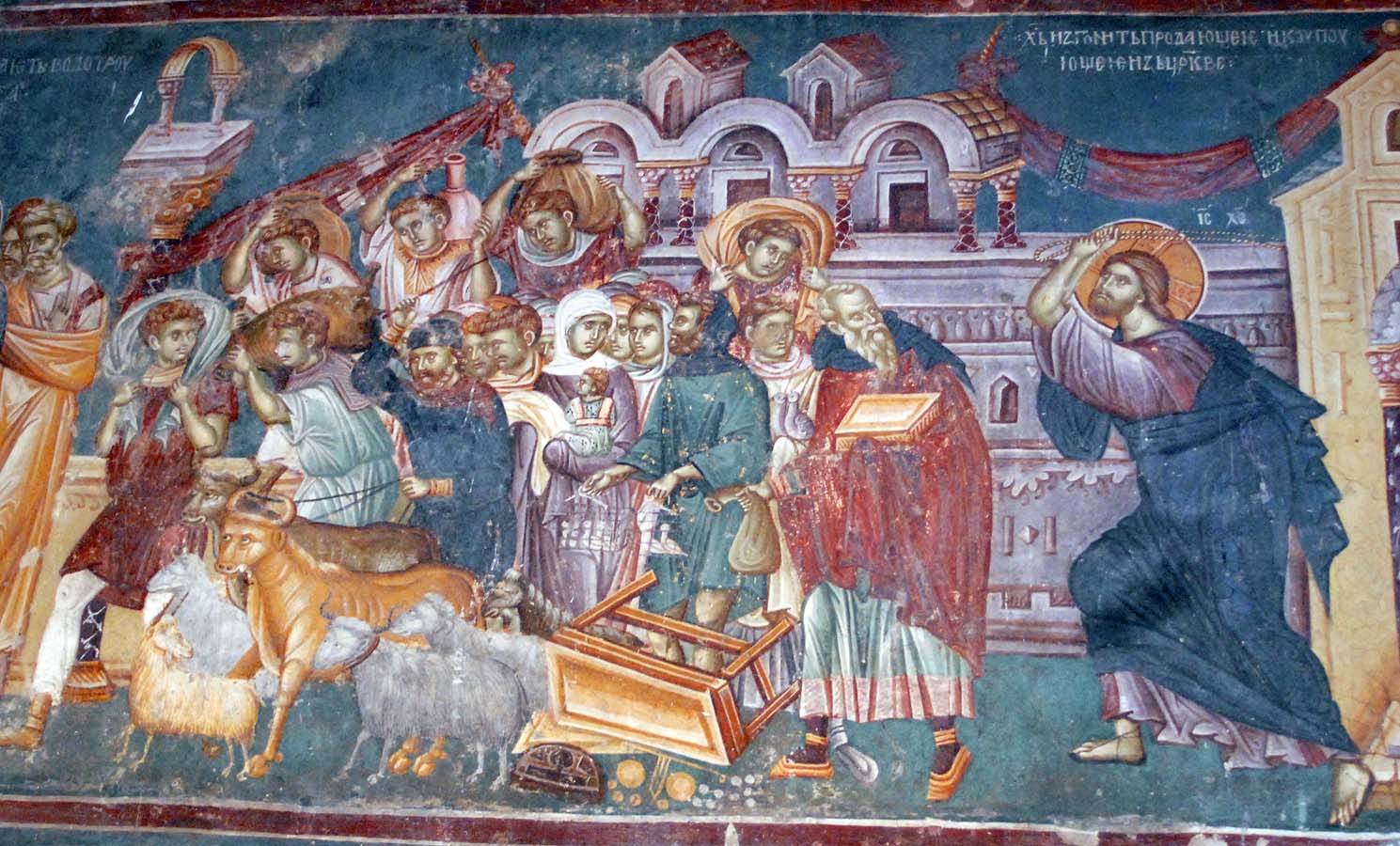
His action in the Jerusalem temple proclaimed the same judgment:
“Jesus answered and said unto them, I am come to abolish the sacrifices, if ye cease not from sacrificing, the wrath will not cease from you. Destroy this temple, and in three days I will raise it up. Then said the Jews, Forty and six years was this temple in building, and wilt thou rear it up in three days? But he spake of the temple of his body” (Evangelicon 2:21–23).
Christ did not cleanse the temple in order to restore the sacrificial system to a purer form. He announced its abolition and replaced the earthly sanctuary with His own body. The true meeting place between God and humanity is not an altar of animal blood, but Jesus Christ.
The destruction of the Jerusalem temple in 70 C.E. ended the regular sacrifices conducted there. The termination of that cult corresponded with the declaration of Christ that the age of the Law and its temple had come to an end.
This does not mean that every person connected with the temple was consciously serving Satan or that the same devil worshiped at Delphi was necessarily the lawgiver worshiped at Jerusalem. The Marcionite distinction is theological rather than a careless identification of all lower religions with one spirit.
The sacrificial system belonged to the lower covenant and did not reveal God the Father. In the Apellean understanding, the Hebrew deity and his demands belonged to the fabricated mythology of the Hebrew Bible. In the Lucanist understanding, the Law and its sacrifices proceeded from the just but inferior ruler of the lower world. In neither case did they come from the Father revealed by Christ.
The abolition of sacrifice also does not reduce Holy Communion to a merely symbolic meal. Holy Communion is a true Holy Mystery. Through the words of Jesus Christ and the operation of the Holy Spirit, the bread and mixed chalice truly become the body and blood of Christ.
The Eucharist is not a repetition of temple slaughter or a renewed offering of animal blood. It is the Church’s thanksgiving, remembrance, communion, and participation in the body and blood of the once-given Christ. It belongs to the new covenant of grace and is celebrated within the Divine Liturgy by a bishop or presbyter.
The Lord’s table is therefore opposed to the table of devils. At pagan altars, worshipers entered fellowship with lower powers. At the Lord’s table, the faithful receive Christ and are united by the Holy Spirit as one body.
Paul declares:
“The cup of blessing which we bless, is it not the communion of the blood of Christ? The bread which we break, is it not the communion of the body of Christ? For we being many are one bread, and one body: for we are all partakers of that one bread” (I Corinthians 10:16–17).
The end of blood sacrifice was accompanied by liberation from the ordinances that maintained the lower religious order. Christ took the handwriting of ordinances that stood against mankind and nailed it to His cross. Having abolished those ordinances, He triumphed over the principalities and powers that administered them.
Paul writes:
“Christ hath redeemed us from the curse of the law” (Galatians 3:10).
And again:
“Stand fast therefore in the liberty wherewith Christ hath made us free, and be not entangled again with the yoke of bondage” (Galatians 5:1).
Christian freedom is not lawlessness. The faithful remain subject to the Law of Christ: faith, love, purity, mercy, forgiveness, humility, charity, and obedience to the Holy Spirit. They have been freed from the lower covenant so that they may serve God the Father in the newness of the Spirit.
Paul proclaimed this victory with incomparable clarity. His Gospel came through the revelation of Jesus Christ, not through submission to Jerusalem, pagan philosophy, or the traditions of men. He announced that Christ stands above every angelic, political, religious, and cosmic power.
The Gospel must therefore never be subordinated again to the Law or joined to the worship of pagan powers. Paul warns:
“But though we, or an angel from heaven, preach any other gospel unto you than that which we have preached unto you, let him be accursed. As we said before, so say I now again, If any man preach any other gospel unto you than that ye have received, let him be accursed” (Galatians 1:8–9).
An angelic power possesses no authority to contradict the revelation of Christ. A law attributed to an angel, ruler, prophet, oracle, or ancient god must be judged by the Gospel. Christ alone reveals God the Father.
The later suppression of pagan sacrifice under Christian emperors gave political expression to a spiritual victory already accomplished through the death and resurrection of Christ. By the end of the fourth century, imperial laws prohibited pagan sacrifices and restricted access to the temples. The shrines that had dominated the religious life of the nations lost their public authority.
Yet Christ’s triumph does not depend upon imperial law, political force, or the destruction of buildings. His victory is manifested wherever a soul turns from idols, rejects fear, receives the Gospel, invokes the name of Jesus Christ, and is delivered from the power of darkness.
The powers of the present age continue to work through idolatry, spiritual deception, political domination, false religion, violence, greed, and the blinding of unbelieving minds. Their decisive defeat has already occurred, but their influence continues until the final consummation of Christ’s victory.
The Church therefore remains engaged in spiritual warfare:
“For we wrestle not against flesh and blood, but against principalities, against powers, against the rulers of the darkness of this world, against spiritual wickedness in high places” (Laodiceans 6:12).
Our enemies are not nations, races, or human communities. The Church does not wage war against flesh and blood. It resists the spiritual powers that enslave souls and the falsehood, hatred, cruelty, and idolatry through which those powers work.
The faithful overcome them not through violence but through faith, truth, prayer, charity, the Holy Mysteries, the proclamation of the Gospel, and the name of Jesus Christ. We bear witness that God the Father is above every lower ruler and that Jesus Christ is Lord.
Christ has silenced the devils, abolished blood sacrifice, destroyed the dominion of the Law, and exposed the rulers of the present age. He has not merely defeated one supposed deity while leaving the larger structure of bondage untouched. He has triumphed over every principality and power.
The god of the Jews is not God the Father. Satan is not God. The world-fashioning powers are not gods. The gods of the nations are not gods. None is equal to the Father, none is the source of the Gospel, and none possesses a rightful claim over those who belong to Christ.
The Apellean and Lucanist traditions differ concerning the identity of the lower ruler, Satan, and the deity portrayed in the Hebrew Bible. They stand together, however, in confessing the supremacy of God the Father and the universal lordship of Jesus Christ.
The oracles have fallen silent. The dominion of sacrifice has ended. The ordinances that stood against us have been nailed to the cross. The principalities and powers have been spoiled, and the light of the Gospel has entered the world.
Let no man return to the tables of devils, the bondage of the Law, or the fear of lower powers. Let no man confuse the Father of Jesus Christ with the rulers of this age. Let the Church stand fast in the liberty of Christ and proclaim His triumph until every power is placed beneath His feet.
In Him, we are made free.