


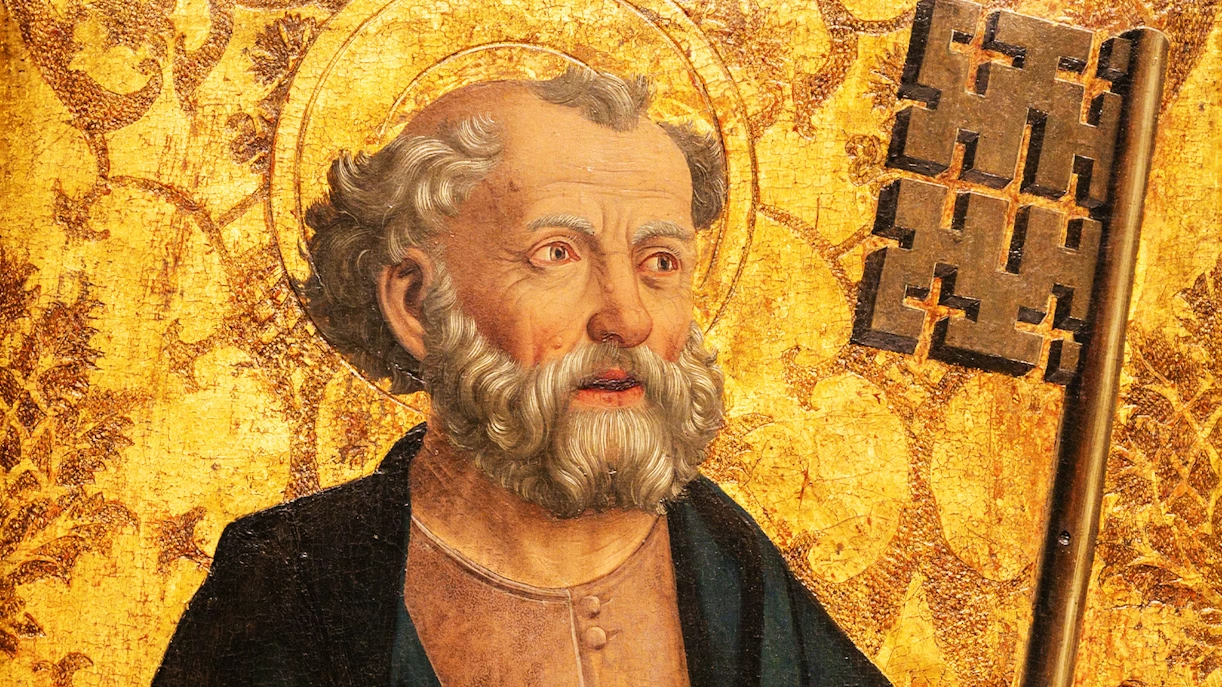

From the vantage point of the Marcionite Church, the moment when the Lord renames Simon as “Peter” is not a charter for Petrine supremacy or for the later claims of the Catholic Church. It is a prophetic and judgment-laden naming that discloses Simon’s future role as the hardened, earthly foundation of a Judaizing, compromised community. The “rock” here is not the foundation of the true church of God the Father, but the emblem of a mixed religion that seeks to drag the new gospel back under the Law of the Hebrew Bible and under Yahweh’s false covenant.
The mainstream tradition reads the new name as an elevation: Peter is the stable stone upon which the visible church is built, the first in a line that culminates in Rome’s primacy. Yet this sits uneasily with the portrait of Peter: the disciple who repeatedly misunderstands the Lord, denies Him under pressure, fears the circumcision party, and compromises fellowship with Gentile believers. From a Marcionite perspective, to present such a figure as the unproblematic foundation of the spiritual church is implausible.
The Marcionite reading retains the historical renaming but reverses its theological value. Christ truly calls Simon “Peter,” yet the name functions more as prophecy than praise. The rock is less a symbol of firm fidelity under the new and true covenant than of the hard, weighty intrusion of the old and false—Yahweh’s false covenant—into the sphere of the new.
Before the renaming, “Simon” aptly depicts a man who hears. He leaves his former life, follows Christ, confesses Him, and often responds with genuine zeal, though not always with complete understanding. In this state, he stands between one old and false covenant and one new and true covenant: on one side, Yahweh’s false covenant and the Law of the Hebrew Bible, grounded in a false deity; on the other, the covenant of the one true God, God the Father, whose gospel of grace will be fully articulated by the Apostle Paul.
The new name “Peter” shifts the image. A rock is hard, resistant to reshaping, heav,y and earthbound. In Marcionite theology, this describes a soul that remains fundamentally attached to Yahweh’s false covenant and to the Law. The rock calls to mind stone tablets and stony hearts that cannot receive the fullness of the Father’s mercy. It is a fitting sign for a disciple who will struggle to rise above Yahweh’s justice to the revelation of God the Father.
Thus, the name “Peter” marks what Simon will become: the embodiment of a half-converted religiosity that clings to the Hebrew Bible even as it hears the gospel. The new and true covenant does not come to mend Yahweh’s false covenant, but to expose and supersede it. The renaming is therefore less a coronation than a diagnosis of Peter’s future role in the history of the churches.
This role appears more clearly in the later distinction between a “gospel of the circumcision” and a “gospel of the uncircumcision.” Peter is associated with the former, Paul with the latter. Around Peter, a community gathers that strives to preserve continuity with the Hebrew Bible while confessing Christ, retaining circumcision, food laws, and other practices associated with Yahweh’s false covenant. The “rock” becomes the theological justification for merging the new and true covenant with the old and false, and for blurring the distinction between the one true God and a false deity.
Within this framework, Peter is the foundation of the Judaizing church—a compromised structure that mixes the old and the new. His name is invoked to defend the continued use of the Hebrew Scriptures as if they were the direct word of God the Father and to bind the gospel under ordinances derived from Yahweh’s false covenant. In this sense, the rock is the heavy base upon which an entire misdirected edifice rests.
At the same time, the rock is also a stumbling block. What serves as a base for one building becomes a hazard underfoot for others. Peter’s fear of the circumcision party and his withdrawal from fellowship with the uncircumcised make him a cause of offense, leading many away from the liberty given by the one true God and back into Yahweh’s legal regime. His example draws believers away from the new and true covenant toward the shadows of the old and false.
Seen this way, Christ’s naming of Peter has an intensely ironic edge. The same title that later tradition will treat as the foundation of the Catholic Church is, for Marcionites, a warning embedded in the gospel narrative. It signals that the authority built on Peter’s name is intertwined with a return to the Law and to the prestige of the Hebrew Bible, and thus with the claims of a false deity.
Opposed to Peter stands Paul. Peter remains tied to earthly Jerusalem, to apostles who still esteem the Law, and to an ecclesiology that seeks continuity with Yahweh’s false covenant. Paul receives the gospel directly from Christ, without human mediation. His message does not rest on the old and false covenant; it proclaims a salvation that is independent of and superior to that dispensation. In Marcionite thought, Paul, not Peter, is the true foundation of the church of God the Father, because only Paul proclaims the gospel entirely free from the entanglements of the Hebrew Bible and from the claims of a false deity.
The contrast is sharp. Peter embodies earthbound attachment to the old and false order; Paul represents the heavenly calling that breaks with it. Peter is the rock because he will carry the weight of Yahweh’s false covenant into the sphere of the new. Paul speaks of a new creation and of a freedom that cannot coexist with bondage to the Law. The renaming of Simon marks the divergence between an institutional, Judaizing church gathered around Peter and a spiritual, Pauline church that acknowledges only the one true God, the Father revealed in Christ, and refuses to submit again to Yahweh’s commandments.
This reading has clear ecclesiological implications. If “Peter” is a prophetic sign of compromise, then claims of Petrine supremacy rest on a misreading of that sign. The church that grounds itself in continuity with the Hebrew Bible, elevates Peter as supreme apostolic authority, and claims universality on that basis, appears, to Marcionites, as precisely the Judaizing institution whose rise the renaming episode anticipates. The rock in this story is not the bedrock of the true church, but the stone upon which a mixed and earthbound religion has chosen to build, conflating the one true God with a false deity and the new and true covenant with Yahweh’s false covenant.
The Marcionite Church, by contrast, locates its foundation in the revelation entrusted to Paul. The true church rests not on stone but on heavenly disclosure. It is not constructed out of continuity with Yahweh’s false covenant, but out of faith in the one true God whom Christ reveals as distinct from Yahweh and from every false deity. To insist that the church is “built on the rock” of Peter is, from this perspective, to admit that one has chosen the weight and hardness of the old and false over the freedom and lightness of the new and genuine.
The episode of Simon’s renaming thus becomes a lens for reading subsequent church history. It explains the emergence of a dominant institution that is heavy, juridical, and deeply invested in the authority of the Hebrew Bible, even while it claims to follow Christ. It clarifies why that institution often stands in tension with the radical freedom and grace proclaimed by Paul. And it supports the Marcionite conviction that the true church must distance itself from Petrine claims, from Yahweh’s false covenant, and from the worship of a false deity, and return to the pure Pauline gospel of the one true God, God the Father.
Ultimately, the Marcionite rationale for Simon’s new name is not that Christ wished to exalt Peter as the immutable foundation of the church, but that He wanted to unveil—through a single, potent symbol—the trajectory of a disciple and of an institution. The “rock” marks hardness, heaviness, and earthbound religiosity, and warns against a community that would fuse Christ with the Law and the one true God with a false deity. For this reason, the Marcionite Church refuses to build upon that rock and instead looks to the Apostle Paul and the revelation he received as the only secure foundation for the church of God the Father.