

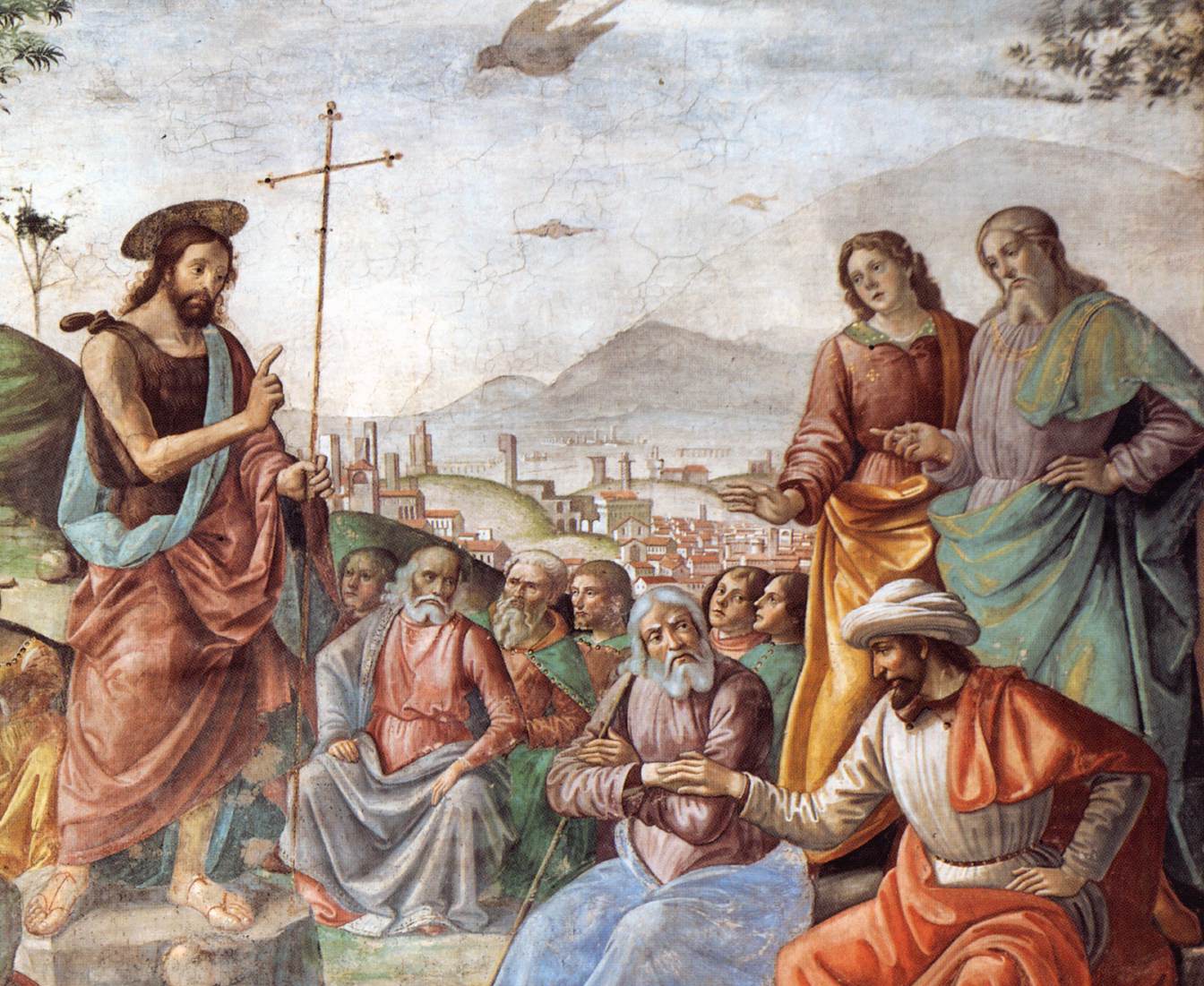
In the Evangelicon, John the Baptist appears as the divinely sent forerunner and prophet, the first true prophet of Christ’s testament, who prepares, bears witness, and then yields the stage to Christ. He stands as an earthly witness at the moment of heavenly arrival: “There was a man sent from God, whose name was John… He was not that Light, but was sent to bear witness of that Light” (Evangelicon 1:6–8), and “John bare witness of him” (Evangelicon 1:15).
We also state plainly what we confess: John is not a prophet of the false deity known as Yahweh, but a prophet of the true God, the Father, who sent Christ. His witness belongs to the Father’s saving revelation and is utterly independent of Judaic prophecies, rites, rituals, and scriptures. John witnesses the heavenly descent, “Jesus descended out of heaven into the Galilean city of Capernaum” (Evangelicon 2:2), serves as a forerunner rather than a foundation, and hands his disciples to Jesus before sealing his testimony in martyrdom.
Mainstream Gospel Narrative
In the mainstream Gospels, John both prepares and—especially in the Synoptics—inaugurates Jesus’ public ministry through the Jordan baptism (Matthew 3:13–17; Mark 1:9–11; Luke 3:21–22). Luke supplies birth narratives and a kinship link between the families (Luke 1–2). Elias typology is explicit: John comes “in the spirit and power of Elias,” and Jesus identifies him as the Elias who was to come (Luke 1:17; Matthew 11:14; 17:10–13; cf. John 1:21). In the mainstream Gospels, John’s knowledge of Jesus is mixed: early recognition sits alongside later uncertainty (Matthew 3:14; 11:2–3; Luke 1–2; 7:18–20; John 1:29–34). All these frames John as a prophet within Hebrew-Scripture fulfillment and Second Temple continuity—as a prophet of the false deity known as Yahweh.
John the Baptist in the Evangelicon
In the Evangelicon, the delineation is sharp: the narrative opens with Jesus descending out of heaven into Capernaum (Evangelicon 2:2), and there is no nativity, no genealogy, no baptism of Jesus by John, and no kinship or meeting between them narrated. Christ appears and acts on the authority of the Father. John, for his part, is not tied to prophecies from the Hebrew Bible and stands outside the frameworks, institutions, and typologies of Second Temple Judaism—no Elias identification, no “voice in the wilderness” formula, no priestly lineage, no temple setting. Instead, he consistently bears witness to the One from above: he recognizes the heavenly origin (“He that cometh from above is above all”), rejoices as the Bridegroom’s friend, and confesses, “He must increase, but I must decrease” (Evangelicon 2:72–74; cf. 2:77; 1:6–8; 1:15). Though tested in prison and seeking confirmation for his disciples’ sake, he hands his disciples over as his own course ends (Evangelicon 5:19–28). Accordingly, in Marcionite confession, John is the Father’s prophet, not a prophet of the false deity known as Yahweh; his baptism is “from heaven,” and his testimony accords with the Father’s witness to the Son (Evangelicon 5:29–30; 7:34–35; 18:4).
John’s Preaching and Baptism
John’s ministry is real and weighty. He calls to repentance—“O generation of vipers… the axe is laid unto the root… every tree… is hewn down, and cast into the fire” (Evangelicon 2:80–83)—and the response divides the public: “All the people, and the publicans, justified God… but the Pharisees and lawyers rejected the counsel of God” (Evangelicon 5:29–30). In the Evangelicon, Jesus’ ministry is not inaugurated by a baptism from John; John’s baptism marks preparation and judgment, not Christ’s commissioning.
The Transition of Practices: Fasting and Prayer
The transition from forerunner to Christ occurs through practice rather than a baptismal rite. Fasting gives way to the Bridegroom’s presence and “new wine” (Evangelicon 3:53–57). The narrative then marks a hinge: “The law and the prophets were until John: since that time the kingdom of God is preached” (Evangelicon 16:16–17). When the disciples ask, “Lord, teach us to pray, as John also taught his disciples,” Jesus gives the prayer—another concrete handoff from the forerunner’s instruction to Christ’s own (Evangelicon 11:1).
The Prison Inquiry as the Baptism-Replacement
As John’s course ends, he sends two disciples from prison—“Art thou he that should come? or look we for another?”—and Jesus answers with deeds: “the blind see… the dead are raised… to the poor have good tidings been announced,” then adds the beatitude. After the messengers depart, He publicly calls John “more than a prophet,” yet declares, “he that is least in the kingdom of God is greater than he” (Evangelicon 5:19–23; 5:26; 5:28). In the Evangelicon this prison inquiry functions as the baptism-replacement: John always knows whom he is witnessing, may be tested under imprisonment, never meets Jesus, and hands his disciples to Christ as his own work concludes (Evangelicon 5:19–28).
Lamp and Greater Witness
Christ honors John—“a burning and a shining light”—but directs hearers to the higher validation: “I receive not testimony from man,” pointing instead to His works and to the Father’s witness (Evangelicon 7:31–35). Jesus thus stands vindicated by His works and by the Father’s testimony.
The Authority Challenge in the Temple
In the temple controversy, Christ leverages John’s public credibility to expose hostile leaders: “The baptism of John, was it from heaven, or of men?” When they refuse to answer, He replies, “Neither tell I you by what authority I do these things,” and warns of the stone that breaks or grinds those who stumble (Evangelicon 18:4–9).
Herod’s Perplexity and John’s Martyrdom
The court first registers perplexity—“John have I beheaded: but who is this?”—and the beheading follows, sealing John’s witness in blood (Evangelicon 8:7–9; 8:10–22). John’s footprint is intentionally limited: he prepares, bears witness, and departs.
Conclusion
John is the Father’s prophet—the divinely sent forerunner and the first true prophet of Christ’s testament—who prepares, bears witness, and hands his disciples to Christ. Jesus acts with the Father’s authority, receives no testimony from man, and is vindicated by works and by the Father. From that point, the Evangelicon’s focus rests on Jesus, who descended out of heaven and stands revealed (Evangelicon 2:2).