


In the eleventh chapter of the First Epistle to the Corinthians, preserved in the Apostolicon of the Testamentum, the Apostle Paul addresses a grave disorder within the Corinthian assembly. The celebration of Holy Communion, which should have manifested the unity of the one body of Christ, had become surrounded by division, selfishness, inequality, and contempt for the poor.
Paul writes:
“For first of all, when ye come together in the church, I hear that there be divisions among you; and I partly believe it” (I Corinthians 11:18).
Disunity within the Church is never merely a private disagreement. It injures the common life of the faithful, contradicts the Gospel, and obscures the unity established through Christ. The Corinthians had allowed distinctions of wealth, status, and influence to govern their conduct even when they assembled for worship.
Their inequality became especially visible at the common meal surrounding the celebration of Holy Communion. Instead of waiting for one another and sharing charitably, some ate abundantly while others remained hungry.
“For in eating every one taketh before other his own supper: and one is hungry, and another is drunken” (I Corinthians 11:21).
Paul sharply rebukes them:
“What? have ye not houses to eat and to drink in? or despise ye the church of God, and shame them that have not?” (I Corinthians 11:22).
Ordinary hunger may be satisfied at home, but Holy Communion is not ordinary food. Neither may the gathering of the Church become an occasion for indulgence, exclusion, or the humiliation of the poor. The faithful assemble not to reproduce the divisions of the world, but to partake together of the one bread and the one cup.
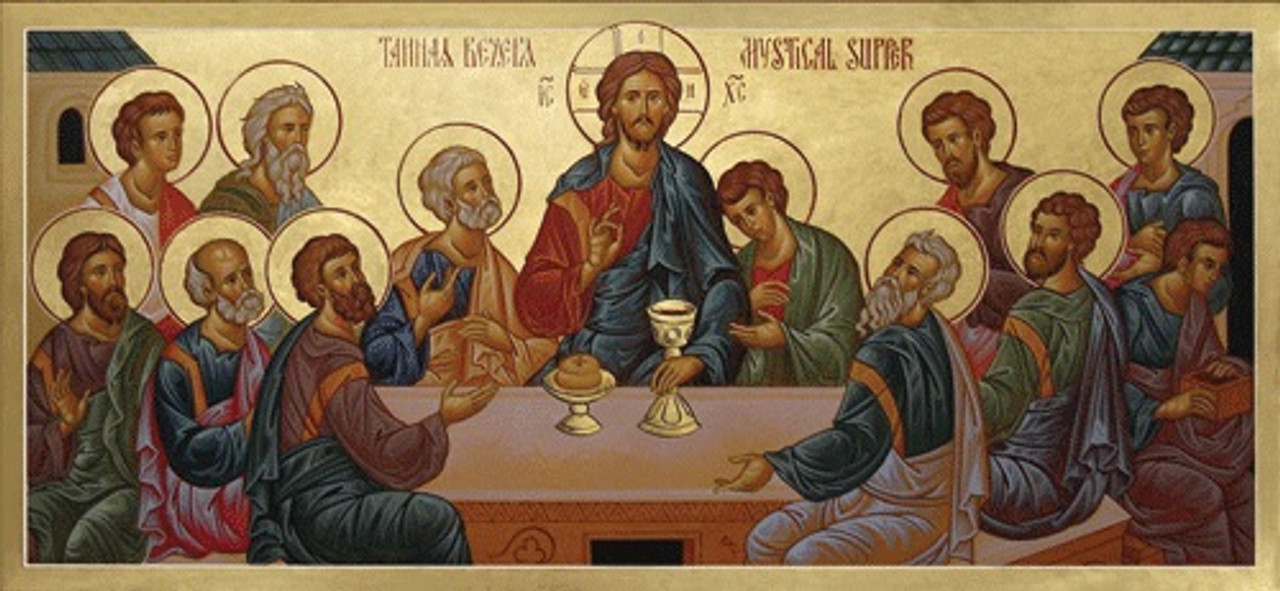
Paul recalls the sacred tradition that he received concerning the institution of the Holy Mystery:
“That the Lord Jesus the same night in which he was betrayed took bread: And when he had given thanks, he brake it, and said, Take, eat: this is my body, which is broken for you: this do in remembrance of me. After the same manner also he took the cup, when he had supped, saying, This cup is the new testament in my blood: this do ye, as oft as ye drink it, in remembrance of me” (I Corinthians 11:23–25).
Holy Communion is one of the three Holy Mysteries of the Marcionite Church, together with Holy Baptism and Holy Chrismation. It is not merely a symbolic representation of Christian fellowship. In the Divine Liturgy, through the words of Jesus Christ and the operation of the Holy Spirit, the bread and the mixed chalice truly become the holy body and precious blood of Christ.
The celebrant speaks the words delivered by the Lord over the bread and the chalice. He then invokes God the Father to send down the Holy Spirit upon the communicants and upon the offering, sanctifying the bread as the holy body of Christ and the cup as His precious blood. The words of Christ and the invocation of the Holy Spirit belong together within the Church’s celebration of the Eucharist.
The command, “This do in remembrance of me,” therefore signifies more than a private act of recollection. In Holy Communion, the Church remembers and proclaims the death and resurrection of the Lord, receives the body and blood of Christ, and participates in the unity established through His saving work.
“For as often as ye eat this bread, and drink this cup, ye do shew the Lord’s death till he come” (I Corinthians 11:26).
Holy Communion proclaims that Jesus Christ gave Himself to deliver us from this present evil world. It testifies that His death has broken the dominion of sin and death and that His resurrection has opened the way to life. The faithful do not merely remember an absent teacher; they receive the communion of the body and blood of the living Christ.
Because Holy Communion is a true Holy Mystery, it must be approached with reverence, faith, repentance, and self-examination.
“But let a man examine himself, and so let him eat of that bread, and drink of that cup” (I Corinthians 11:28).
Self-examination does not mean that communicants must imagine themselves morally perfect or worthy by their own merits. No person receives Christ by personal merit. The examination required by Paul is an honest judgment of one’s faith, conduct, intentions, and relationship with the Church and with one’s fellow communicants.
A person should not approach the Holy Mystery while deliberately nourishing hatred, contempt, pride, exploitation, or division. The communicant must recognize both the body of Christ received in the Eucharist and the one ecclesial body formed by all who partake of the one bread.
“For he that eateth and drinketh unworthily, eateth and drinketh damnation to himself, not discerning the Lord’s body” (I Corinthians 11:29).
To receive unworthily is not to receive while conscious of human weakness. All remain dependent upon grace. It is to approach carelessly, without faith, repentance, charity, or discernment of the sacred gift. The Corinthians failed to discern the Lord’s body when they treated the Eucharistic assembly as an ordinary feast and disregarded the poor members of the same body.
The reality of Christ’s presence makes the ethical demands of Communion more serious, not less. Those who receive the one body cannot rightly despise one another. Those who drink from the one cup cannot preserve the divisions of wealth, status, faction, or personal ambition as though these were greater than their unity in Christ.
The Divine Liturgy is celebrated by a bishop or presbyter, who presides as the celebrant of the Church. Ordained celebration does not establish a privileged spiritual caste or imply that the clergy possess a different Gospel from the faithful. It preserves the apostolic order, doctrinal integrity, and visible unity of the ecclesial assembly.
The celebrant does not perform Holy Communion as a private act or by personal power. He presides on behalf of the Church, proclaims the words of Christ, offers thanksgiving to God the Father, invokes the Holy Spirit, and distributes the Holy Mystery to the communicants. His ministry serves the unity of the Church and ensures that the Eucharist remains an ecclesial act rather than an individual possession.
The distinction between celebrant and communicants does not contradict Christian equality. Equality in Christ does not require the abolition of every ministry, responsibility, or order within the Church. Rather, every ministry must be exercised in charity and service, without domination, pride, or self-exaltation.
Bishop, presbyter, deacon, and lay communicant all depend upon the same grace, confess the same Lord, and belong to the same body. All fully initiated Christians who are admitted to Holy Communion receive the same body and blood of Christ. The wealthy receive no greater portion than the poor, and the clergy receive no different Christ from the laity.
Paul writes:
“For we being many are one bread, and one body: for we are all partakers of that one bread” (I Corinthians 10:17).
The Church’s unity is therefore not merely an idea represented by the bread. It is a spiritual and ecclesial reality established through participation in Christ. The faithful are many persons, yet through the one bread they are joined together as one body.
The invocation of the Holy Spirit in the Divine Liturgy makes this connection explicit. The Church asks that the cup of blessing may be unto the faithful the communion of the blood of Christ, that the bread broken may be unto them the communion of His body, and that the Holy Spirit may unite all who partake.
The Spirit of true unity is not uniformity imposed by force, nor a denial of legitimate order. It is the unity of persons joined in one faith, one hope, one charity, and one participation in Christ. Such unity cannot coexist with contempt for the poor, factional ambition, spiritual pride, or the use of ecclesiastical office for personal domination.
Paul continues:
“For if we would judge ourselves, we should not be judged. But when we are judged, we are chastened of the Lord, that we should not be condemned with the world” (I Corinthians 11:31–32).
Self-judgment is an act of spiritual honesty. The faithful are called to recognize and correct within themselves whatever contradicts the life of Christ. The purpose is not despair, but repentance, reconciliation, and restoration to the common life of the Church.
The word church derives from the Greek ekklesia, meaning an assembly. Christianity is therefore not an isolated or purely individual experience. The faithful are called into a visible community in which they pray together, receive the Holy Mysteries together, support one another, and provide for those in need.
Paul teaches that charity “seeketh not her own” (I Corinthians 13:5). The Eucharistic life of the Church must therefore extend beyond the moment of reception. Those who receive the body and blood of Christ must show patience, mercy, generosity, forgiveness, and concern for the suffering.
The offering for the relief of the poor and the sharing of the Holy Lovefeast express the same charity manifested in Holy Communion. They do not replace the Eucharist, nor are they identical with it. They are ecclesiastical actions flowing from the unity and love that the Holy Mystery establishes and requires.
Paul concludes his correction of the Corinthians with a simple command:
“Wherefore, my brethren, when ye come together to eat, tarry one for another” (I Corinthians 11:33).
To wait for one another is to reject selfishness and acknowledge that the Church does not belong to the strongest, wealthiest, most learned, or most influential. It belongs to Christ, and all who have been joined to Him must receive one another as members of His body.
The Marcionite Church therefore receives Holy Communion as a true Holy Mystery in which the bread and the mixed chalice become the body and blood of Christ through His words and the operation of the Holy Spirit. It is celebrated within the Divine Liturgy by a bishop or presbyter and received by fully initiated communicants in faith, reverence, repentance, and charity.
Holy Communion is at once the reception of Christ, the proclamation of His death and resurrection, and the manifestation of the Church’s true unity. It excludes neither order nor ordained ministry, but it condemns every use of order, wealth, status, or authority that humiliates another member of the body.
Let us therefore approach the Holy Mystery reverently, discerning the body of the Lord and examining our own hearts. Let us put away pride, resentment, selfish ambition, and contempt for those who possess less than ourselves. Being many, let us become manifestly what Christ has made us: one bread, one body, and one Church, united by the Holy Spirit in the grace of God the Father.
Amen.