
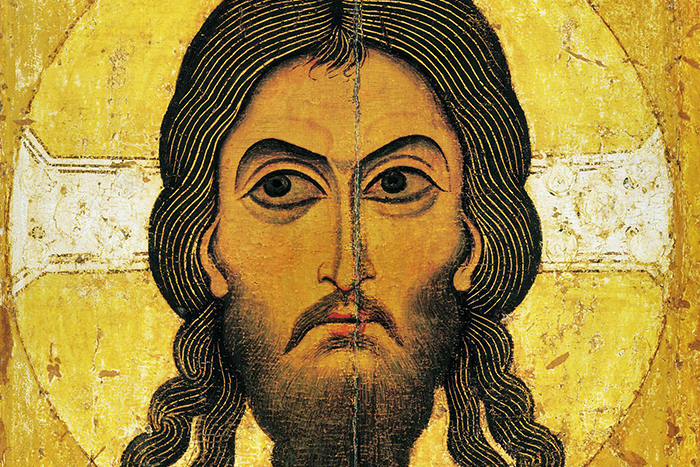
The Marcionite Church affirms the authenticity of the relic known as the Shroud of Turin and identifies it with the ancient Image of Edessa (the Mandylion). We hold that in its earliest Edessan phase, the cloth was preserved within the city’s dominant Marcionite communities—locally called “Christians”—while the local Catholic faction was commonly nicknamed “Palutians.” This reading best fits Edessa’s naming conventions, local polemic, and the literary trail that later brings the Image to Constantinople in 944 CE.
Custodianship at Edessa: “Christians” and “Palutians”
Edessa (Syriac: Urhay) stood in the kingdom of Osrhoene. In local usage, the Catholic faction was often called “Palutians,” after Bishop Palut. Ephrem complains about this label and insists on the undifferentiated name “Christians”: “They called us Palutians, and we escaped that and rejected it… let an anathema be on the one called by the name of Palut, if not by the name of Christ” (Hymns against Heresies 22). The complaint only makes sense if rival communities already claimed “Christians” as their name. In Edessa, Marcionites were early, numerous, and well-organized; Ephrem’s anti-Marcion polemic—pressing the unity of God and Scripture—sets his opponents in view.
The Chronicle of Edessa, drawn from city records, preserves an early local memory: “In the year 449 Marcion forsook the Catholic Church” (Seleucid year 449 = 138/139 CE), showing how directly Edessa remembered Marcion by name.
Marcionite Intellectual Life in the Edessan Orbit
Prepon the Assyrian, described as a follower of Marcion, addressed a work to Bardaisan of Edessa, presenting Marcionite positions and critiquing Bardaisan’s teaching. Eusebius likewise notes Bardaisan’s dialogues against Marcion’s followers “in the region between the rivers,” locating vigorous Marcionite–Edessan engagement precisely when the Image’s reputation was taking shape. On this pattern of names, memory, and controversy, we judge it most plausible that early custodianship of the Image lay with Marcionite Christians.
The Image and the Shroud
Sources from last antiquity describe a God-made image at Edessa credited with protecting the city during a sixth-century siege. On August 15, 944 CE, the Image was translated to Constantinople in a solemn procession. A longstanding line of research identifies the Mandylion with the full-length burial cloth now in Turin, displayed in antiquity folded so that only the face panel was shown (the tetradiplon folding pattern). Other scholars dispute this. We acknowledge the debate; we judge the Edessa→Constantinople literary and liturgical trail most coherent if the Image and the Shroud are the same cloth.
Objections and Replies
- Continuity of custody. The Edessa→Constantinople line is well attested; medieval witnesses in Constantinople shortly before 1204 describe a shroud bearing the figure of the Lord. The subsequent path to France is debated, but the appearance of a shroud relic in France within a few generations is consistent with known movements of relics after the Fourth Crusade.
- Radiocarbon (1988). The tests yielded a medieval date. Pro-authenticity critics argue the sampled corner was from a repaired or contaminated area and therefore not representative of the whole cloth. The question remains contested.
- “Face-only” vs. full-length. The ancient descriptor tetradiplon (“folded in four”) and historical folding displays explain a face-only presentation while the cloth itself remained full-length.
Westward Movement and Later Memory
Imperial and episcopal campaigns in Late Antiquity steadily suppressed Marcionite institutions in Syria. After the Muslim conquest, custodianship of Edessa’s shrines shifted, but the Image’s prestige endured. Its translation to Constantinople in 944 CE placed the relic at the heart of Byzantine devotion. During the events of 1204, observers in Constantinople reported a shroud showing the figure of the Lord. In the following generations, a shroud relic appears in France and is later venerated in the Latin West as the Shroud of Turin.
Theological Note
For Marcionite faith, the Shroud’s value is not anchored in the Hebrew Bible of the false deity known as Yahweh, but in the Gospel’s witness to the suffering and risen Lord. Whether called Mandylion or Shroud, the cloth is a witness of Christ—acheiropoieton (“not made by hands”)—that proclaims the goodness of God the Father revealed by Jesus and underscores the reality of the Lord’s flesh, passion, and triumph.
Conclusion
- We affirm the Shroud of Turin as the burial cloth of the Lord Jesus and identify it with the ancient Image of Edessa.
- We judge that in its earliest Edessan phase, the cloth’s preservation rested with Marcionite communities commonly called “Christians,” while the Catholic faction was nicknamed “Palutians.”
- We narrate its journey westward amid the suppression of our communities and shifts in Near-Eastern rule, culminating in its 944 CE translation to Constantinople and later veneration in the Latin West.
Thus, the Shroud stands for us as Edessa’s witness to Christ—preserved by Marcionite hands..